OUR UNIVERSE’S MISSING LINK
Our model of the cosmos needs revision, but not without astronomers first assembling the pieces of a new cosmological puzzle
Reported by Lee Cavendish
© Getty
Observation and theory make up the two pillars of scientific research. Without observations, there is just a theory with no substance, and without theory there is just a series of measurements with nothing to extrapolate from them. But what happens when one does not satisfy the other? Recent research about the expansion of the universe and the model that astronomers use to predict its history has caused tension between these two pillars. It appears as though recent measurements of galactic distances over a hundred million light years away and their respective recession speeds have contributed to a persistent discrepancy that keeps cropping up.
Measuring the distance to galaxies has been a relentless objective of astronomers since the beginning of the 20th century. Although many names can be attached to discovering the expansion of the universe - such as Vesto Slipher, Carl Wirtz, Knut Lundmark and Georges Lemaître - it was the work of an American astronomer called Edwin Hubble, the eponym of a law, a constant and a space telescope, who had the most profound effect on this area of research.
In the 1920s Hubble used a telescope at the Mount Wilson Observatory, California, to study the cosmos in unrivalled precision. By doing this he discovered that what astronomers thought were nebulae - clouds of gas and dust illuminated by internal stars - were actually other galaxies outside the Milky Way. He then went on to measure the distances to these galaxies by studying their internal Cepheid variable stars and inferring the distances using a luminosity-distance relationship.
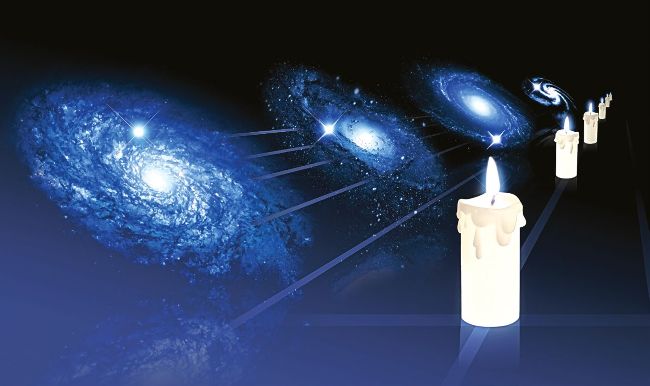
Standard candles are shining examples of astrophysical objects used to calculate cosmic distances
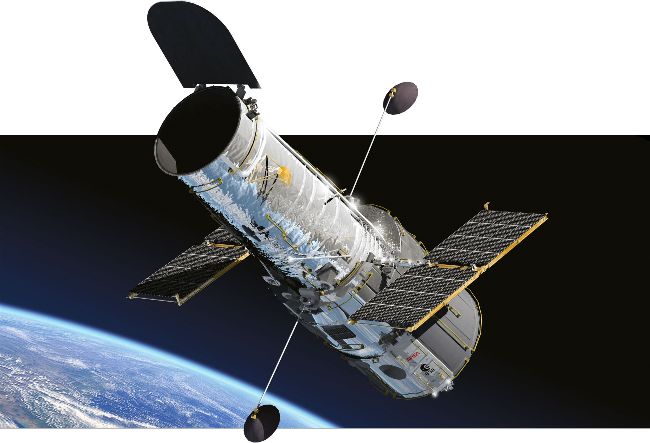
The Hubble Space Telescope has been just as influential to astronomy and cosmology as its namesake
© Adrian Mann
Cepheids were first cited as distance markers in 1912 by another American astronomer, Henrietta Swan Leavitt, who noted that the regular luminosity fluctuation of variable stars can be mathematically manipulated to derive the distance between Earth and that star. This is one class of astrophysical object used to measure distances, commonly referred to as ‘standard candles’. By studying Cepheids in distant galaxies and using measurements gathered by other astronomers, Hubble was able to obtain distance measurements for 46 galaxies and uncover something truly groundbreaking.