BL ACK HOLES
How do we know they’re real?
Once purely theoretical, now there’s hard evidence these high-gravity objects exist
Reported by Andrew May
© Tobias Roetsch
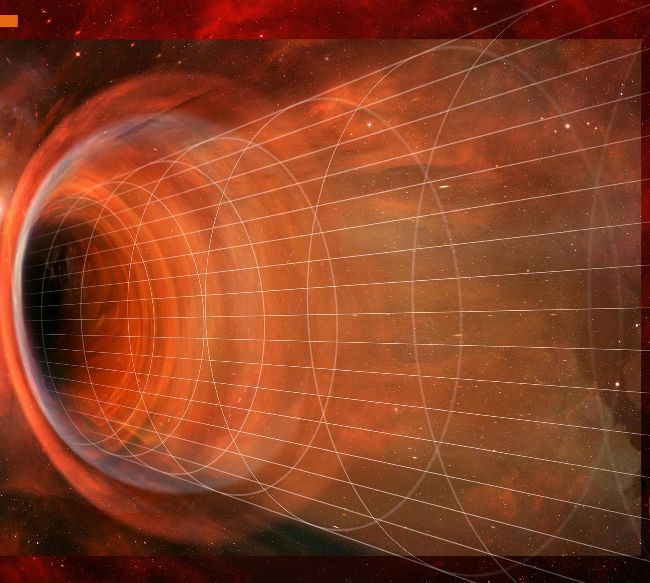
Of all the far-out concepts in astronomy, black holes may be the weirdest. A region of space where matter is so tightly packed that nothing – not even light itself – can escape, these dark behemoths present a pretty terrifying prospect. With all the normal rules of physics breaking down inside them, it’s tempting to dismiss black holes as the stuff of science fiction. Yet there’s plenty of evidence – both direct and indirect – that they really do exist in the universe.
Einstein’s ‘robust
prediction’
As a theoretical possibility, black holes were predicted in 1916 by Karl Schwarzschild, who found them to be an inevitable consequence of Einstein's theory of general relativity. In other words, if Einstein's theory is correct – and all evidence suggests it is – then black holes must exist. They were put on even firmer ground by Roger Penrose and Stephen Hawking, who showed that any object collapsing down to a black hole will form a singularity where the traditional laws of physics break down. This has become so widely accepted that Penrose was awarded a share in the 2020 Nobel Prize in Physics “for the discovery that black hole formation is a robust prediction of the general theory of relativity.”