MYSTERIES OF THE UNIVERSE
WHAT CAUSES LIGHTNING SUPERBOLTS?
Superbolts have the potential to be very destructive, yet scientists still don’t know why they pack more power than ordinary lightning
Reported by David Crookes
© GettY
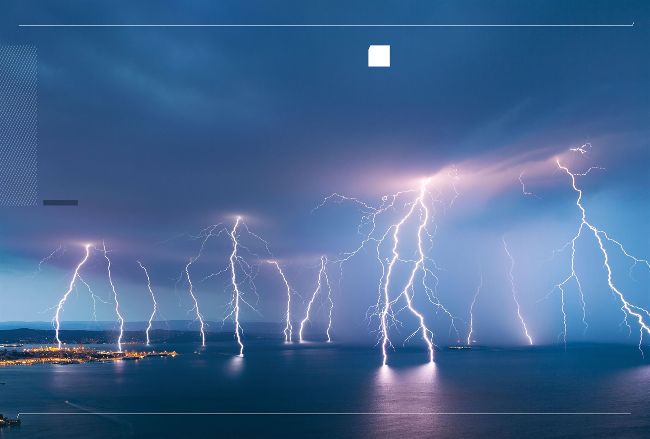
L ightning strikes are something to fear. Around 2,000 people are killed by them each year, and aside from causing many more injuries, lightning has the power to destroy objects too. But there’s a type of lightning you wouldn’t want to encounter. Called superbolts, they don’t happen all that often, “yet they’re 1,000 times more powerful than typical lightning,” says Jean-Francois Ripoll, senior scientist at the Commissariat à l’Énergie Atomique (CEA) in Paris. “Superbolts are also potentially very destructive.” But their cause and nature remain unknown decades after being discovered.
First reported in 1977, they were originally observed after the US Department of Defense developed Project Vela in 1963, a program that sought to find ways of monitoring nuclear explosions on or around Earth as the Cold War went on. By sending four satellites into orbit, the US was able to keep an eye on activity and ensure the Soviets were sticking to the 1963 Partial Test Ban Treaty. But the array of instruments on board those satellites, which included X-ray, neutron and gamma-ray detectors, also greatly aided science. Not only did Project Vela make one of the biggest space discoveries when it detected gamma-ray bursts, it also picked up on bright and energetic blasts. “They were genuinely brighter than most other lightning by
definition, and that’s how they became identified in 1977 from Vela satellite measurements,” Ripoll explains. “The brightest events were so bright that their energy had to be far above the energy that was thought lightning could have.”
From that moment on, scientists were unsure whether the observations actually pointed to a so-called superbolt. There was every chance these superbolts were simply normal lightning observed from a favourable satellite angle – that certain viewing conditions would affect their brightness and lead to an erroneous conclusion. But if they were real, scientists needed to find an explanation for how they formed.