GB
  
You are currently viewing the United Kingdom version of the site.
Would you like to switch to your local site?
6 MIN READ TIME

USER MANUAL

GAIA

For nine years, this Milky Way mapper has pinpointed over a billion stars to create an expansive dataset
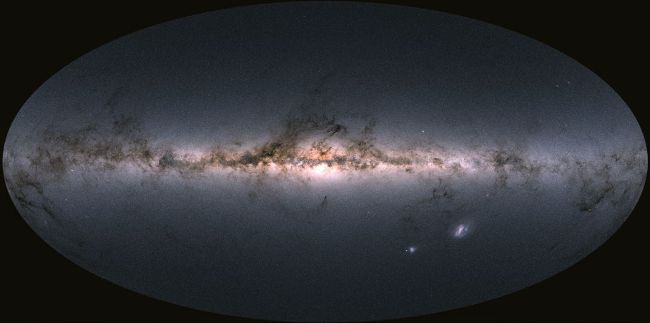
This sky map from Gaia is based on measurements of nearly 1.7 billion stars, showing off the galactic plane, interstellar dust and neighbouring galaxies his almost sombrero-shaped spacecraft has been mapping the stars of our galaxy for nine T years. Its first data release contained unrivalled information on nearly 1.7 billion stars, and is to date the greatest catalogue of stars ever produced. The European Space Agency (ESA) initially had the idea of using Gaia as an optical interferometer mission – meaning that Gaia originally would have been a series of smaller telescopes working together to create an image similar to that of a larger telescope – thus the ESA gave the mission its original name: the Global Astrometric Interferometer for Astrophysics, or GAIA. After the mission evolved and the interferometer idea was dropped, the name stuck. However, the previous design was altered and Gaia’s primary objective would be to create the largest, most precise three-dimensional map of the stars in our galaxy within its intended five-year mission, building on the legacy of the Hipparcos mission.
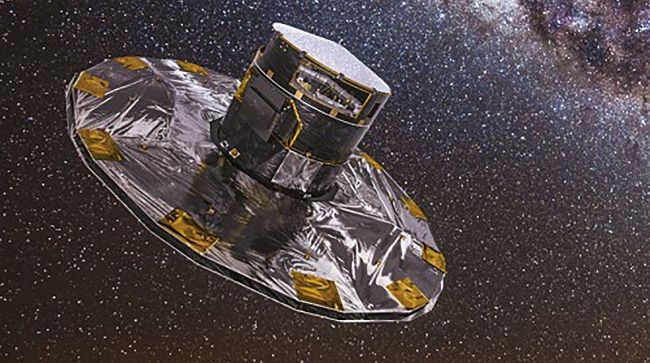
The name wasn’t the only aspect that changed. Launch was originally scheduled for December 2011. After a series of complications to Gaia and the liftoff schedule, the spacecraft finally left Earth two years behind schedule, riding aboard a Soyuz-Fregat rocket. With a launch mass of 2,030 kilograms, Gaia was sent on its way to its new home at Lagrange point 2 (L2) roughly 1.5 million kilometres (932,057 miles) away from Earth. This is an ideal location to observe the wider universe, and is a cosmic ‘parking spot’ which relies on the gravity of the Sun and Earth to keep the space observatory fixed in this one spot. While at L2, Gaia is in a Lissajous-type orbit that has a period of about 180 days around a fixed point at L2.

Unlock this article and much more with
You can enjoy:
Enjoy this edition in full
Instant access to 600+ titles
Thousands of back issues
No contract or commitment
Try for 99p
SUBSCRIBE NOW
30 day trial, then just £9.99 / month. Cancel anytime. New subscribers only.


Learn more
Pocketmags Plus
Pocketmags Plus

This article is from...


View Issues
All About Space
Issue 138
VIEW IN STORE

Other Articles in this Issue


WELCOME
WELCOME
ISSUE 138
Future
FOUR DIGITAL EDITIONS OF HISTORY OF WAR
LAUNCHPAD
Early days of star formation
© NASA The newest space telescope on the
New view of the Cone Nebula
© ESO A dramatic new image of the
Turbulent times in a stellar nursery
Two puffs of star-making material exude mystical glows
Cosmic leftovers reveal that galactic cannibal Andromeda feasts on smaller galaxies
The Andromeda Galaxy has likely been growing by
NASA awards Texas company $57 million for a lunar construction system
A nascent off-Earth construction system just got a
A lab -grown black hole may prove Stephen Hawking’s most challenging theory right
An illustration of a black hole Scientists have
China completes the world’s largest solar telescope array, with a whopping 313 dishes
China has completed construction of what is now
Futureplc
futureplc.com
UNMISSABLE SPACE EVENTS 2023
There are many astronomy events and space missions to look forward to over the next 12 months
FUTURE TECH
ASTEROID NETS
A space fishing trip could capture an asteroid and bring it closer to Earth to study
INTERVIEW
“All missions are unique and interesting”
The European Space Agency (ESA) is preparing for its first-ever mission to Jupiter’s moons. All About Space speaks to the mission’s project scientist, Olivier Witasse, to find out why the Galilean satellites are so appealing
FOCUS ON
NASA’S PERSEVERANCE ROVER OPENS A WINDOW TO MARS’ WATERY PAST
The Perseverance rover is approaching its one-year anniversary since landing on 18 February 2021
DARK ENERGY?
The universe’s expansion is accelerating under the influence of a mysterious force, but could this emerge from multiple sources?
LIVES OF THE ANIMAL ASTRONAUTS
These creatures boldly went where few humans had gone before
X-RAY VIEW SHOWS HOW SUPERMASSIVE BLACK HOLES SPEED UP PARTICLES IN JETS
Blazars are powered by immensely active galatic centres that fire beams of particles into space
UNRAVELLING ANCIENT SOL AR SYSTEMS
The discovery of a white dwarf with high levels of lithium and potassium has provided fresh insights into early planet formation
Do smaller stars generally host smaller planets?
Planets form from the constant accumulation of material
What Earth-like features does Titan have?
The Huygens lander reached Titan’s surface in 2005
How do we know the universe’s age?
The expansion of the universe reveals its
How close would a supernova have to be to destroy life?
If a supernova were to go off within
Why are there no gas moons?
Of all the moons in our Solar System,
What exists outside our observable cosmos?
There are some questions that science just can’t
What do radio observations reveal about the centre of the Milky Way?
© NASA/JPL; ESO ; Getty; Virgin Galactic Radio
ASTROPHOT FOR BEGINNERS TOGRAPHY
Learn the art of photographing the night sky with All About Space
KNOW YOUR EQUIPMENT
Here’s a guide to the kit you’ll need for your astrophotography adventures
PLAN YOUR SHOOT
Check the weather Keep a close eye on
GET A STAR-PACKED IMAGE
Easy steps for great results
CAPTURE STUNNING NIGHTSCAPES
Shoot incredible night-sky shots with minimal equipment
How you can image the majesty of the Milky Way
Without question, the Milky Way is one of
CREATE A STAR TRAIL
Capture the world in motion with these easy steps
PICK THE BEST SPOT
You might already have a location in mind
NIGHTSCAPES AT A GLANCE
Constellations Exposure: 15 to 40 seconds Aperture: f/2
SHOOT CELESTIAL BODIES
Whether the Moon or planets are your target, here are the essentials you need to get the best outcome
THE BASICS OF NIGHT-SKY SHOOTS
If you don’t have a DSLR camera, don’t
BRING THE DEEP SKY TO YOU
Further afield there are galaxies and nebulae galore
INSTANT EXPERT
DOES THE SUN STAY STILL IN THE SOLAR SYSTEM?
We tend to think of our star as the stationary centre of our system, but the planets do make it wobble
USER MANUAL
A LOPSIDED STAR CLUSTER MAY DISPROVE NEWTON AND EINSTEIN’S THEORIES
An uneven distribution of stars in several nearby clusters may offer evidence of MOND – acontroversial theory of gravity that rejects the existence of dark matter
STARGAZER
In this issue...
What’s in the sky? 78 Ring in the
WHAT’S IN THE SKY?
What to look out for during this observing period
Jargon buster
Conjunction An alignment of objects at the same
PLANETARIUM
MOON CALENDAR The Moon does not pass the
THIS MONTH’S PLANETS
Venus takes pride of place in the evening sky as we head into the New Year
WOLF
Finding this lunar crater won’t leave you howling with frustration on cold January nights
NAKED EYE AND BINOCULAR TARGETS
How to see sparkling stars and distant misty galaxies this month
OBSERVE THE UNICORN’S SPARKLING TREASURES
Winter skies are rich in deep-sky objects for your telescope to hunt down and enjoy. Here are just a select few
THE NORTHERN HEMISPHERE
The New Year has arrived, with some of the very best night-sky targets
ASTROSHOTS OF THE MONTH
BASUDEB CHAKRABARTI Location: Yousmarg, Kashmir “Deep-scape images line
SKY-WATCHER EXPLORER 130
A Newtonian reflector that’s versatile, affordable and optically impressive with an equatorial mount to view Solar System objects, double stars and deep-sky targets
IN THE SHOPS: DEEP-SPACE TELESCOPES
Use one of the best telescopes for deep space to tour the universe
WERNHER VON BRAUN
The father of rocket science went from working for the Nazis to becoming an American space hero
ALL ABOUT SPACE
Future PLC Quay House, The Ambury, Bath, BA1
Chat
X
Pocketmags Support