GB
  
You are currently viewing the United Kingdom version of the site.
Would you like to switch to your local site?
19 MIN READ TIME

WATER ON MARS

AND 24 OTHER AMAZING DISCOVERIES ON THE RED PLANET

1 MARS LOOKS LIKE A DEAD PLANET

Since the invention of the telescope in the 1600s, astronomers have been fascinated by the surface of Mars. It’s too far away to resolve from Earth, and the atmospheres of both planets interfere with the passage of light, but they noticed dark and light patches that moved as the year passed, speculating that they might belong to clouds, seas and even forests. In the 19th century, Italian astronomer Giovanni Schiaparelli described a series of channels that he saw in the surface of the planet, imagining that there might be water on the surface, but a mistranslation of the Italian word ‘canali’ led American scientists, most notably Percival Lowell, to believe that the Red Planet was actually covered in canals, possibly built by intelligent life.

Hopes of an Earth-like planet were dashed when NASA’s Mariner 4 captured the first ever close-up images of the surface during a flyby in 1965. The 22 stills showed craters, reminiscent of the scarred surface of the Moon, and revealed the planet to be a barren waste covered in red dust and rubble. Measurements detected no magnetic field, and barely any atmosphere. For years after, scientists thought Mars was a dead planet whose geological activity stopped billions of years ago. But subsequent missions revealed that there’s much more to Mars than meets the eye.

Schiaparelli observed ‘channels’ on Mars
© NASA; Getty; Webb

2 MARTIAN DUST IS MAGNETIC

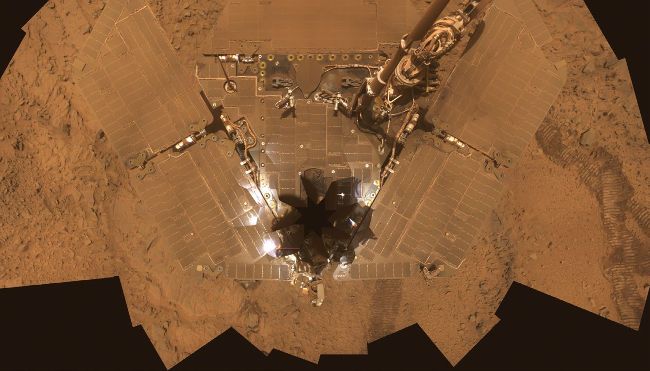
The Red Planet owes its distinctive colouration to iron, which was detected in high quantities in the soil by the Viking landers in 1976. Its surface is coated in a fine layer of dust, which after billions of years of winds and storms has been ground down to a consistency finer than talcum powder. The Imager for Mars Pathfinder (IMP), attached to the Carl Sagan Memorial Station, which landed in 1997, used the difference in atmospheric brightness throughout the day to measure the size of the airborne dust particles, revealing that they measure about three microns in diameter on average. In 2004, NASA’s Spirit rover carried permanent magnets to the surface of the planet to probe the dust further, confirming that almost all of the dust on Mars is magnetic, whether in the air or on the ground. Two angled magnets captured particles from the atmosphere, revealing different oxides of iron, strongly magnetic dark material that is either magnetite or maghemite plus lighter, less magnetic haematite. The rover also carried a strong magnet near its panoramic camera that repelled the dust, protecting the equipment and ensuring the images remained clear.

3IT’S HOME TO THE TALLEST MOUNTAIN IN THE SOLAR SYSTEM

The first orbiter to visit Mars was NASA’s Mariner 9, tasked with mapping 70 per cent of the surface. When it arrived in 1971, the planet was engulfed in a dust storm that completely obscured the view of the ground below, and the orbiter had to wait for several months for the dust to settle. As the storm subsided, the highest points were revealed first, and four enormous volcanoes started to appear above the sinking clouds. They were large and domed in appearance, and the sides had gentle slopes reminiscent of shield volcanoes on Earth.

The tallest of the Martian shield volcanoes is Olympus Mons, measuring 624 kilometres (374 miles) across and extending nearly 26 kilometres (16 miles) above the ground. It easily dwarfs every other peak identified in the Solar System to date. For comparison, the tallest volcano on Earth, Mauna Kea in Hawaii, extends 10,200 metres (33,400 feet) above the floor of the Pacific Ocean.

Unlock this article and much more with
You can enjoy:
Enjoy this edition in full
Instant access to 600+ titles
Thousands of back issues
No contract or commitment
Try for 99p
SUBSCRIBE NOW
30 day trial, then just £9.99 / month. Cancel anytime. New subscribers only.


Learn more
Pocketmags Plus
Pocketmags Plus

This article is from...


View Issues
All About Space
Issue 139
VIEW IN STORE

Other Articles in this Issue


ALL ABOUT SPACE
WELCOME ISSUE 139
SCAN HERE TO GET OUR DAILY NEWSLETTER What
LAUNCHPAD
An Orion Nebula image tells a dramatic tale
images Kean A stunning new image of a
Exposed heart of a galaxy
© ESA/Hubble & NASA, S. Kulkarni, Y. Chu
Fireworks from a stellar death
© ESA/Hubble & NASA, S. Kulkarni, Y. Chu
Detecting life on Saturn’s moon Enceladus would require 100 flybys through its geyser plumes
KEEP IN TOUCH /AllAboutSpaceMagazine @spaceanswers space@spaceanswers.com An illustration
Fireball traced to a strange rocky meteoroid from the edge of the Solar System
A rocky meteoroid that exploded over Canada last
NASA’s InSight lander recorded its biggest quake on Mars ever
A selfie taken by the InSight lander on
NASA cancels climate change satellite to monitor greenhouse gases
NASA has cancelled the Geostationary Carbon Cycle Observatory
FUTURE TECH
SHAPESHIFTING SPACECRAFT
Futuristic robotic explorers could seamlessly switch between swimming and spelunking
INTERVIEW
“Dad was one of the greatest teachers ever”
Although Nick Sagan didn’t follow in the footsteps of his father, astronomer Carl Sagan, his novels, TV shows, movies and video games have clearly been influenced by his love of space
FOCUS ON
A BREAKTHROUGH SIMULATION MAY UNITE QUANTUM PHYSICS AND GENERAL RELATIVITY
It could suggest a way to study ‘quantum gravity’, the missing link between quantum physics and general relativity, in a laboratory
DIY SPACE PROJECTS
Have some spare time on your hands? Check out these activities that can be done at home
A MEGATSUNAMI SWEPT OVER MARS AFTER A MASSIVE ASTEROID HIT THE RED PLANET
The impact left a huge crater behind
HUBBLE CAPTURES A DAZZLING EMBRACE OF MERGING GALAXIES
The mutual gravity during the collision is warping the structures’ shapes to form a ring
WHY DOESN’T JUPITER HAVE PROMINENT RINGS?
Given how massive Jupiter is, the gas giant should theoretically have a set of thick rings, so why are they so thin?
I want to get started in astronomy. Where do I begin?
Astronauts get the very best views of the
INSTANT EXPERT
ARE DWARF STARS REALLY THAT SMALL?
There are different classifications of dwarf stars, and
ARE WE LIVING IN A MULTIVERSE?
Could our entire universe be just one small part of many? The evidence is mounting up…
THE DIFFERENT TYPES OF MULTIVERSE
From unseen regions of space-time to complex structures, there are four distinct levels
LIFE IN THE MULTIVERSE
The physical laws of our current universe are
STAR PROFILE
ETA CARINAE
This star has refused to die thus far, but astronomers are sure it’s going to blow up soon
NEWS FROM ETA CARINAE
Why didn’t the star die? In 2018, two
TEN AMAZING SPACE STATION EXPERIMENTS
The International Space Station is more than just an outpost in space – it’s a huge orbiting research laboratory
STARGAZER
WHAT’S IN THE SKY?
What to look out for during this observing period
PLANETARIUM
10 FEBRUARY 2023
THIS MONTH’S PLANETS
Venus enters the evening sky, prepared to dazzle astronomers
TIMOCHARIS
Go on a sightseeing tour of a little crater with a very violent past
NAKED EYE AND BINOCULAR TARGETS
February’s night sky is rich in pretty star clusters and bright colourful stars
THE EXOTIC NIGHT SKY OBJECTS OF GEMINI
3 The Jellyfish Nebula (IC 443) Dig deep
THE NORTHERN HEMISPHERE
Orion fades to the southwest while Leo climbs from the east
ASTROSHOTS OF THE MONTH
A portion of the Veil Nebula ANDREI PLESKATSEVICH
ASTRONAUT STARRY SKY STAR PROJECTOR
Perfect for any space fan, this charming device offers great value for money with a great deal of fun thrown in
IN THE SHOPS: BEST SMARTPHONES FOR ASTROPHOTOGRAPHY
1 Apple iPhone 13 Pro Max Cost: £1,549
JEFFREY A. HOFFMAN
The first astronaut to log more than 1,000 hours on board the Space Shuttle and the man who helped save Hubble
ALL ABOUT SPACE
Future PLC Quay House, The Ambury, Bath, BA1
Chat
X
Pocketmags Support