GB
  
You are currently viewing the United Kingdom version of the site.
Would you like to switch to your local site?
14 MIN READ TIME

HIDDEN UNIVERSE

Much of the cosmos goes undetected by our eyes. All About Space peers beyond visible light to reveal the explosive and catastrophic behaviour of the universe

©Alamy

If we only relied on our eyes, we would be blind to most of what the universe has to offer. There would be so much that we I would completely miss, from the explosive nature of gamma-ray bursts to the dusty skeletons of galaxies and even the radiation left behind by the Big Bang. This is because the universe emits light that goes well and truly beyond what our eyes alone can see. Visible light, which is the light that we see making up our everyday surroundings, is just one small part of the electromagnetic spectrum. This runs all the way from low-energy radio waves through to astonishingly high-energy gamma rays.

Human eyes are unable to see anything that’s outside of the visible part of the spectrum, so you might be surprised to learn that we produce this hidden light on Earth, too. Think of infrared night-vision goggles, the X-rays you might get to see a broken arm, ultraviolet security tags or radio waves transmitting music and telephone calls across the planet. But in space these wavelengths of light are everywhere, coming from all kinds of cosmic objects. It’s like a hidden universe, but luckily for us, astronomers are able to tune in to these other wavelengths to make the invisible visible.

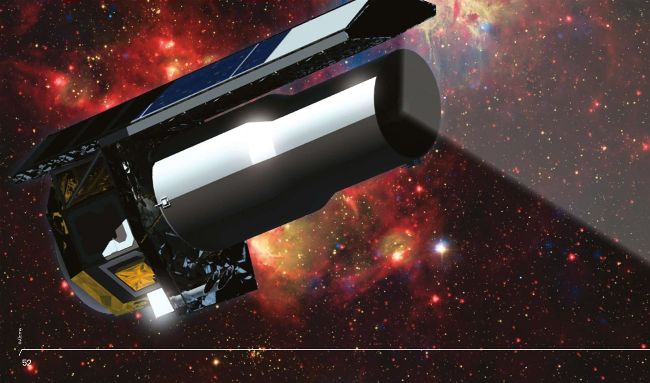
Light is a funny thing – it’s able to act like both a wave and a particle at the same time, and this is why we say that a photon of light can have a wavelength. The longest wavelengths are radio waves, which range from a millimetre in length to many kilometres. Meanwhile, the shortest wavelengths on the electromagnetic spectrum belong to gamma rays and can be as small as a trillionth of a metre. To reveal this hidden light, astronomers need a variety of tools, from giant bowl-shaped radio dishes that can be seen from miles around to detectors in orbit above Earth’s obscuring atmosphere.

This other light remained hidden until its discovery at the beginning of the 19th century. It was the year 1800 when William Herschel used a prism to split light into a spectrum of colours and measured the temperature of each shade. He came to the conclusion that there must be an extra unseen colour beyond red, because his thermometer was responding to light in the spectrum that he could not see – the infrared. A year later, German scientist Johann Ritter conducted a similar experiment, but this time found that unseen light beyond violet had the ability to darken paper soaked with silver chloride – ultraviolet had been discovered.

Unlock this article and much more with
You can enjoy:
Enjoy this edition in full
Instant access to 600+ titles
Thousands of back issues
No contract or commitment
Try for 99p
SUBSCRIBE NOW
30 day trial, then just £9.99 / month. Cancel anytime. New subscribers only.


Learn more
Pocketmags Plus
Pocketmags Plus

This article is from...


View Issues
All About Space
Issue 151
VIEW IN STORE

Other Articles in this Issue


All About Space
WELCOME ISSUE 151
SCAN HERE TO GET OUR DAILY NEWSLET TER
All About Space
Future PLC Quay House, The Ambury, Bath, BA1
LAUNCHPAD
Euclid ‘dark universe’ telescope captures its first full-colour views of the cosmos
Globular cluster NGC 6397 Irregular galaxy NGC 6822
Webb gazes into a galactic garden of budding stars
© Webb Telescope This stunning spiral isn’t a
A major star factory near the Milky Way’s black hole
© Webb Telescope Behold a region of intense
Supernova wreckage in a hazy galaxy
© ESA The Hubble Space Telescope snapped a
‘Alien’ spherules dredged from the Pacific are probably just industrial pollution
KEEP IN TOUCH /AllAboutSpaceMagazine @spaceanswers space@spaceanswers.com Based on
Chinese scientists build a model Mars atmosphere to aid sample -return plans
Chinese scientists have constructed a numerical model to
JUICE will use the gravity of Earth and the Moon to slingshot to Jupiter
An artist’s depiction of the JUICE spacecraft travelling
Japan’s ispace unveils a micro rover for its second Moon mission
A computergenerated image of the micro rover that
Distant ‘ teenage galaxies’ surprise astronomers with unexpected heavy elements
Young galaxies from the early universe as seen
The first black hole ever imaged by humanity is losing huge amounts of energy through ‘lightsaber’ jets
The Event Horizon Telescope captured this image of
WIN A CELESTRON NEXSTAR 4SE TELESCOPE WORTH OVER £450
This fantastic computerised telescope is up for grabs this month
ULTIMATE GUIDE TO COMETS
• WHERE THEY COME FROM • HOW THEY
FOCUS ON
SCIENTISTS FIND HYDROGEN IN APOLLO MOON ROCK SAMPLES
Future astronauts could harvest water on the lunar
STELLAR VAMPIRES MAY FEED ON HIDDEN STARS IN THEIR SYSTEMS
Some massive stars may exist in systems of not just two, but three interacting stellar bodies
THE MILKY WAY’S STUNNING SPIRAL STRUCTURE APPEARS TO BE AN ANOMALY
Some galaxies meant to be spirals might have been smoothed out into clumpy ellipticals
SPACE MISSIONS OF 2024
All About Space guides you through the space missions and events set to fire your imagination over the coming year
A HIGH-ENERGY PARTICLE OPENS UP POSSIBILITIES FOR NEW PHYSICS
The mysterious new particle doesn’t have a clear point of origin
ASTEROID PHAETHON’S MYSTERIOUS TAIL MAY FINALLY HAVE AN EXPLANATION
The space rock, born at the birth of the Solar System, has long puzzled astronomers
HOW DO SUPERMASSIVE BLACK HOLES FORM?
Astronomers have discovered a supermassive black hole that existed 470 million years after the Big Bang, and it’s proving to be enlightening
A NASA INSTRUMENT ON THE ISS IDENTIFIES MORE THAN 750 GREENHOUSE GAS SOURCES
The agency’s EMIT instrument, originally built to map minerals, is exceeding expectations
ASK SPACE
Artist’s concept of OSAM-1 SPACE EXPLORATION How do you
WHAT WOULD FALLING THROUGH URANUS’ ATMOSPHERE FEEL LIKE?
Wind tunnels show what a probe descending into the atmosphere of an ice giant may have to contend with
THE ASTRONOMER'S GUIDE TO STAR PARTIES
Astronomy doesn’t have to be a lonely hobby. Wherever you live, there will be a star party near you
FUTURE TECH
A MANNED MISSION TO VENUS
Once believed to be off limits for human exploration, NASA is considering how Venus might be better to visit than Mars
INTERVIEW
“The blue of Earth is not only a colour, it’s also a light… it actually glows”
Astronaut Thomas Pesquet reveals the challenges of photographing Earth from space, the psychological importance of being able to see our planet out the window and how he selected the photos for his new book, The Earth in Our Hands: Photos from the International Space Station
STARGAZER
WHAT’S IN THE SKY?
What to look out for during this observing period
PLANETARIUM
THIS MONTH’S PLANETS
Mercury offers the perfect observation opportunity in the morning sky
SCHILLER
To start off the New Year, spot one of the strangest shaped craters on the Moon
NAKED EYE AND BINOCULAR TARGETS
How to see sparkling stars and distant misty galaxies this month
OBSERVE THE UNICORN’S SPARKLING TREASURES
The winter skies are rich in deep-sky objects for you and your telescope to hunt down and enjoy. Here are just a select few
NORTHERN HEMISPHERE
Get stuck into a plethora of galaxies, nebulae and star clusters
CELESTRON UPCLOSE G2 10x50 BINOCULAR
Large objective lenses and 10x magnification help this affordable piece of kit appeal to anyone wanting to start stargazing
IN THE SHOPS: APOLLO MISSION GIFT GUIDE
LEGO Lunar Lander Cost: £89.99 / $99.99
BUZZ ALDRIN
The second man on the Moon, Aldrin was instrumental in the success of the Apollo missions
Chat
X
Pocketmags Support