BETELGEUSE
THE STELLAR GIANT THAT SHOULD HAVE EXPLODED
The mysteries of this red supergiant star have baffled astronomers for centuries, but have we moved a step closer to solving them?
Reported by Libby Plummer
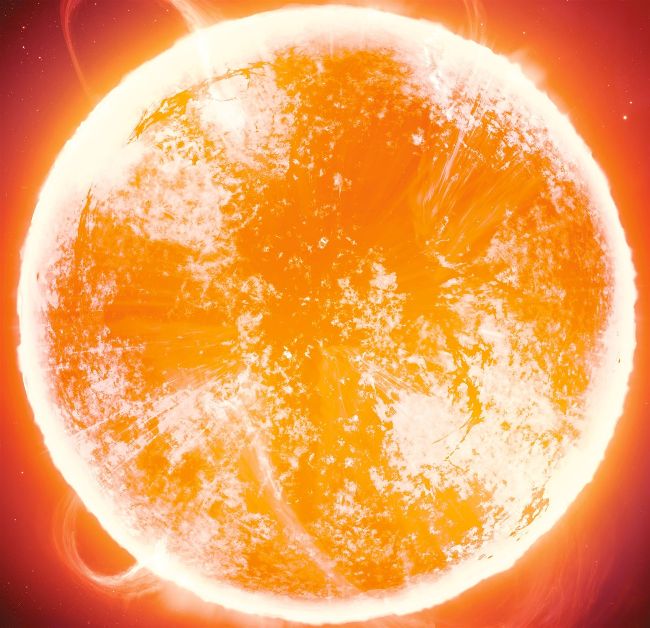
Betelgeuse was first observed centuries ago, but our knowledge of the orange-red star is still surprisingly vague. The red supergiant, B which is in the twilight years of its life, is the second-brightest star in Orion, marking the Hunter’s right shoulder. Red supergiants are the largest known type of star, and Betelgeuse is the closest one to Earth – roughly 600 light years away. Although the star’s intense brightness means that it’s been observed for centuries, its mysterious behaviour continues to leave scientists baffled. One of the latest bizarre findings was revealed in a study that suggested that the star is spinning much faster than previously thought, and may have even swallowed up a companion star some 100,000 years ago. This is odd because usually as a star grows to become a supergiant, its rotation slows down. However, the research found that Betelgeuse is actually spinning much faster than expected. “We cannot account for the rotation of Betelgeuse,” says J. Craig Wheeler of the University of Texas at Austin. “It’s spinning 150 times faster than any plausible single star, just rotating and doing its thing.”
It was this puzzlingly high rotation speed that led the researchers to speculate that Betelgeuse may have had a companion star when it was first born. The researchers estimate that the nearby star would have had roughly the same mass as our Sun to account for Betelgeuse’s current spin rate of 15 kilometres (9.3 miles) per second. Given this scenario, “when it finished burning hydrogen in its centre, the core of Betelgeuse contracted and the outer envelope of unburned hydrogen expanded drastically. It is this expansion that we envisage might have engulfed its companion,” Wheeler tells All About Space.