GB
  
You are currently viewing the United Kingdom version of the site.
Would you like to switch to your local site?
17 MIN READ TIME

Feature

BECOME AN ASTRONOMER

If the starry skies inspire you with wonder and curiosity, you have the right stuff to become an astronomer

Part one

Humans have been awed by the night sky for countless millennia. We know so much more about the universe than our ancestors, but the same visceral feelings about the vast, silent majesty of the cosmos sweep through our senses.

A wealth of objects and phenomena delight night-sky viewers. Some objects, like the stars, star patterns and constellations, are permanent fixtures in the cosmic tapestry, acting as guideposts to understanding and finding your way around the heavens. Other objects, like the Moon and planets, move along a highway through the constellations and appear to change over time. A few phenomena, like comets, meteors and the northern lights, are relatively fleeting but spectacular sights. Some sky events can be predicted with great accuracy, while others spring wonderful visual surprises.

There are enough sights in the night sky to keep astronomers enthralled for a lifetime. By probing the universe further using binoculars or telescopes, astronomers eager to explore the cosmos are capable of revealing a staggering panorama beyond Earth. Moreover, new technology in the form of high-resolution electronic cameras, in conjunction with computer-controlled telescopes, enable far more of the universe to be observed than the eye at the eyepiece alone can take in.
© Getty

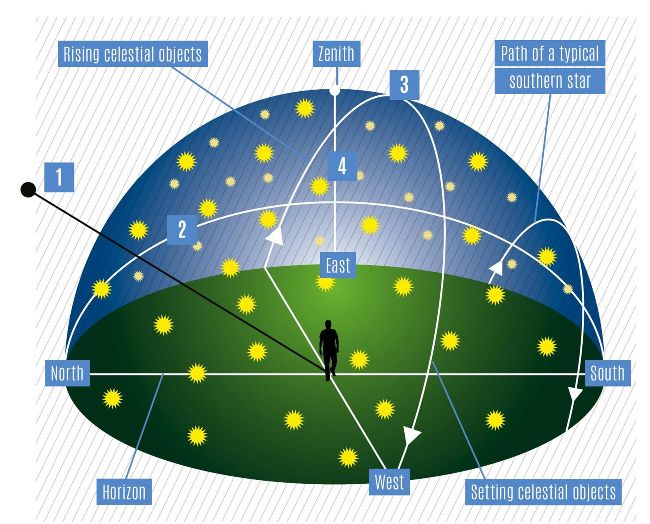
THE SKY AROUND YOU

As Earth rotates, the stars rise and set, tracing arcs at various heights above the horizon

1 North celestial pole

The northern point in the sky about which all of the stars seem to rotate around the North Star, also known as Polaris.

2 Right ascension

Right ascension is to the sky what longitude is to the surface of Earth, corresponding to east and west directions. It’s measured in hours, minutes and seconds since as Earth rotates we see different parts of the sky through the night.

3 Celestial equator

A great circle on the celestial sphere that lies in the same plane as Earth’s terrestrial equator and is tilted at roughly 23.5 degrees to the ecliptic.

4 Declination

How high an object will rise in the sky. Like Earth’s latitude, declination measures north and south. It’s measured in degrees, arcminutes and arcseconds. There are 60 arcminutes in a degree and 60 arcseconds in an arcminute.

UNDERSTANDING THE NIGHT SKY

Knowing how the heavens work is essential before you get started in astronomy

Learning the basics is key to being able to maximise your enjoyment of astronomy. Being able to find individual objects – whether they’re permanent fixtures within constellations, such as double stars, star clusters or nebulae, or transitory visitors such as planets, comets or asteroids – depends on knowing where to look. At first it may seem a daunting task to learn the layout of the skies, the positions of the main constellations and the names of the brightest stars. But time is on your side – there’s no rush, and the thrill of being able to identify star patterns and individual stars remains with you forever and is a skill that you can pass on to others.

Unlock this article and much more with
You can enjoy:
Enjoy this edition in full
Instant access to 600+ titles
Thousands of back issues
No contract or commitment
Try for 99p
SUBSCRIBE NOW
30 day trial, then just £9.99 / month. Cancel anytime. New subscribers only.


Learn more
Pocketmags Plus
Pocketmags Plus

This article is from...


View Issues
All About Space
Issue 153
VIEW IN STORE

Other Articles in this Issue


ALL ABOUT SPACE
WELCOME ISSUE 153
SCAN HERE TO GET OUR DAILY NEWSLETTER If
LAUNCHPAD
Hubble uncovers supernova secrets
15 January 2024
Cassiopeia A’s ‘Green Monster’
8 January 2024
The aftermath of two stellar explosions
3 January 2024
Juno reveals Jupiter’s volcanic moon Io like never before
30 December 2023
NASA eye s a possible ISS extension for astronaut missions
An artist’s impression of the ISS © Getty
Our shrinking Moon could cause moonquakes near the Artemis astronauts’ landing site
When plotting sites for crewed lunar landings, mission
Hubble spots water around a tiny, hot and steamy exoplanet
An illustration of GJ 9827 d – a
Juno picks up hints of activity on Jupiter’s icy moon Europa
The surface of Europa © Getty; NASA NASA’s Juno
Hidden star discovery reveals ‘old smokers’ and ‘screaming’ newborns
An artist’s interpretation of an ancient ‘old smoker’
NASA’s Perseverance rover confirms the presence of an ancient lake on Mars, and it may hold clues to past life
Artist’s impression of a Martian lake © Getty
ANDROMEDA
THE ONE-TRILLION-STAR GALAXY
FUTURE TECH
THE RELATIVITY DRIVE
Could the engine of our science-fiction dreams be on the horizon? 
INTERVIEW
Youngest man on the Moon
Charles Duke
FOCUS ON
TRUE-COLOUR IMAGES REVEAL THAT URANUS AND NEPTUNE ARE SIMILAR BLUES
Although the familiar Voyager 2 images of Uranus were published in a form closer to true colour, those of Neptune were stretched and enhanced, making them too blue
HUBBLE SEES WILD WEATHER RAGING ON A DISTANT HOT JUPITER
Extreme heating and tidal locking result in fierce cyclones and powerful storms in the atmosphere of WASP-121 b
20 ASTOUNDING PHOTOS OF THE SOLAR SYSTEM
Join All About Space’s tour of some of the very best images of our neighbouring bodies
A SIMULATION RECONSTRUCTS A VIOLENT CLASH AS A MONSTER BLACK HOLE SPAGHETTIFIES A STAR
A new reconstruction tells the full story of a star ripped apart by a ravenous black hole in a tidal disruption event
SECRETS OF GRAVITY
We seem to understand how it behaves, but scientists are now finding out how mysterious this force really is
ONE OF THE CLOSEST GALAXIES TO THE MILKY WAY MAY BE HIDING A SECOND GALAXY
New observations of the Small Magellanic Cloud show that it might actually be two galaxies disguised as one
A HUGE RING IN THE SKY
MYSTERIES OF THE UNIVERSE
EARTH’S WATER MIGHT HAVE COME FROM ANCIENT SPACE ROCKS
Water might have existed in the building blocks of our world
ASK SPACE
The Coma Galaxy Cluster is an example of ‘dark
EARLY GALAXIES WERE SHAPED LIKE SURFBOARDS AND POOL NOODLES
Focus on
CONGRESS TELLS NASA THAT THE US MUST BEAT CHINA BACK TO THE MOON
FOCUS ON
STARGAZER
WHAT’S IN THE SKY?
What to look out for during this observing period
Positions
THIS MONTH’S PLANETS
The king of the Solar System takes pride of place, dazzling as the king of the evening sky
BULLIALDUS
Find a crater named after one of the greatest astronomers of the 17th century
NAKED EYE AND BINOCULAR TARGETS
Spring nights are perfect for exploring the wonders of Leo and Cancer
INTRIGUING GALAXIES AND SPARKLING CLUSTERS
Spring is finally here, so now’s the time to go hunting in Coma Berenices and Canes Venatici
NORTHERN HEMISPHERE
Turn your binoculars, telescopes and unaided eyes to the March skies, where there’s plenty on show
CELESTRON STARSENSE EXPLORER DX 102AZ
REVIEW
IN THE SHOPS: NASA GIFTS
Celebrate the American space agency with this range of themed items
LYDE TOM BAUGH
The scientist who discovered Pluto, once the ninth planet of the Solar System
ALL ABOUT SPECE
Future PLC Quay House, The Ambury, Bath, BA1 1UA
Chat
X
Pocketmags Support