UNIVERSE BEFORE TIME
Could the existence of a mirror-image cosmos before the Big Bang solve some of the biggest mysteries in astronomy?
Reported by Giles Sparrow
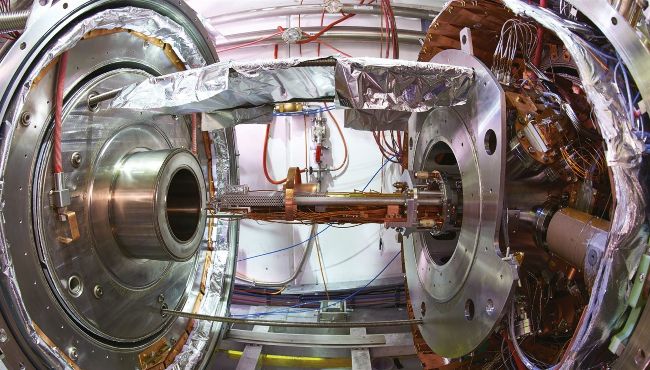
Physicists use the huge machines at the European Organization for Nuclear Research (CERN) in Switzerland to generate and store antimatter for experiments
Our universe encompasses everything around us. Its laws of physics control every possible interaction, from the gravitational attraction that keeps planets in orbit around the Sun to the complex chemistry that gives rise to life. But for astronomers and physicists there are still some big questions about why the universe is the way it is. One of the most famous is the mystery of dark matter, which only makes its presence felt through the influence of its gravity. Another is the dominance of a certain set of subatomic particles – the familiar ones such as electrons, protons and neutrons that we call ‘matter’ – when there was nothing in the Big Bang itself to prevent the formation of equal amounts of ‘antimatter’.
A new theory developed by two Canadian physicists suggests a radical new way of looking at the universe, along the way offering solutions to these and other major questions. According to Neil Turok and Latham Boyle of the Higgs Centre for Theoretical Physics, we may be looking at one aspect of a universe of two halves. Boyle and Turok’s theory, developed with Kieran Finn of the University of Manchester, originates from questions of symmetry. In physics, a symmetric process is one that produces the same result if the values of one or more properties involved are flipped or reversed. A process such as a simple interaction between particles may be symmetric under different transformations of this kind, and as a broad rule of thumb, as structures become more complex they become less symmetric.
“The way Neil and I were thinking about it is if you imagine a cartoon picture of the expanding universe, we’re at the top of a sort of expanding cone, 13.8 billion years after the Big Bang,” explains Boyle. “We can see back in time with astronomical observations, but not all the way back to the Big Bang. What we see is there is a remarkably symmetric universe with very simple properties compared to the universe today. Those simple properties are the fundamental puzzle that early universe cosmologists want to explain – that very special initial state is clearly offering some very important clues as to what was happening in the early universe and how the universe was born. The question is, what is it trying to tell us?”