CRISIS COMMS
GROUP COMMUNICATIONS DURING AN EVACUATION
STORY AND PHOTOS BY JIM JEFFRIES
As a ham radio operator, you are free to choose whatever equipment you wish that meets your communications needs. It can be complex and include advanced features with extended capabilities, or it can be simple and do the bare minimum to establish reliable communications.
Regardless of what you choose, you, as the sole operator, will eventually master it and become quite proficient. Put that same piece of equipment in the hands of someone who does not share your experience, and the results could be quite different.
SELECTING THE EQUIPMENT
In a group setting, a standardized piece of equipment, whether it is a weapons platform or communications gear, should be settled upon and consistently employed. Each member of the group should have experience using the same equipment and will be able to assist others if a problem arises (at least to some degree). Having a group standard also ensures that a part or accessory for that piece of gear—for instance, a charging handle for a rifle or a charging cradle for a radio—is interchangeable.
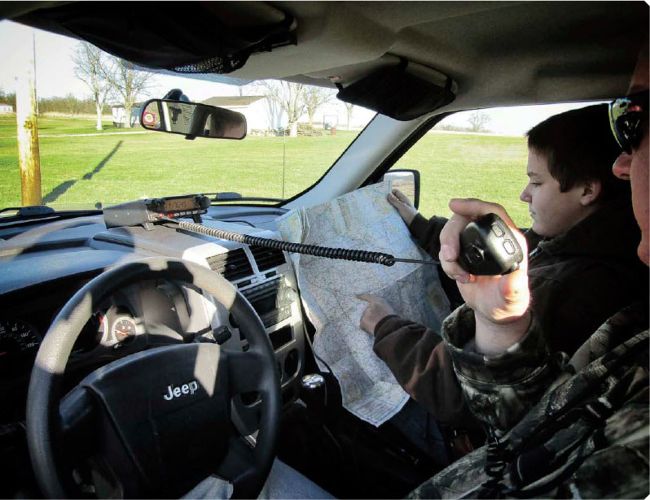
Having a plan is not enough—practicing the plan together beforehand will expose any weakness and offer an opportunity to take corrective measures.
It is important to consider the abilities of the group as a whole when choosing communications gear. If there is little time (or willingness) for training and conducting field exercises, only the most basic equipment might be permissible; complicated radios will lead to confusion—and ultimately, failure—in high-stress situations. If all members are able to spend time in training, more-advanced gear might be suitable.
Of course, the equipment selected must be capable of meeting the requirements set forth by the group. It should have a minimum transmit/receive range of several miles simplex (not using repeaters) in the terrain in which the group normally operates, and it must be reliable in the environment in which it will be used (wet climates require greater water resistance than arid climates). These are just examples; your group might have additional specific requirements.