ROAD TEST No 5632
BMW M2
Munich keeps faith with a three-pedal layout for its smallest M car
PHOTOGRAPHY JOHN BRADSHAW
MODEL TESTED COUPE MANUAL
● Price £66,090 ● Power 453bhp ● Torque 406lb ft ● 0-60mph 4.5sec ● 30-70mph 3.8sec ● Fuel economy 26.5mpg ● CO2 emissions 226-230g/km ● 70-0mph 42.4m
We like
• S58 engine has huge star quality, even in ‘detuned’ form
• Manual gearbox, with its long ratios, is an invitation to engage and enjoy
• Chassis combines nimbleness and comfort, unlike previous M2
We don’t like
• Extra size and weight is apparent in handling, particularly on the limit
• Mutant hot-rod styling generates mixed reactions
• Entry price has gone from £45k to £65k in just seven years
BMW has blown hot and cold with its compact M cars. The 2002 Turbo, the firm’s very first turbocharged road car, set the tone, coming only a year after BMW Motorsport was founded in 1973. But the 2002 had a short life, and after it bigger M cars took centre stage. It wasn’t until the late 1990s, with the Z3-based M Roadster and Coupé, that anything smaller than an M3 received a Motorsport badge.
In 2011, a penny dropped when BMW squeezed a turbocharged straight six into a shrink-wrapped 1 Series Coupé, and the cultish 1M Coupé was born. The original M2 rekindled the 1M’s spirit in 2016 and was a commercial success. And now, in 2023, we have a second-generation M2 Coupé, ready to pick up where its predecessor – by the end of its life, the biggestselling M car of all – left off.
After Munich switched the 1 Series hatch to a more commercially minded front-wheeldrive platform, the 2 Series Coupé could only survive by switching to a shortened 3 Series architecture, so the M2 follows suit. As we are about to explain, the car therefore becomes something larger, more powerful and more capable than any 1M or M2 before it – something more akin to an M 2.5, perhaps.
Read on to find out what implications that has for a car that previous M division executive boards might have considered a sideshow but which certainly demands greater respect now.
DESIGN AND ENGINEERING
★
★
★
★
☆
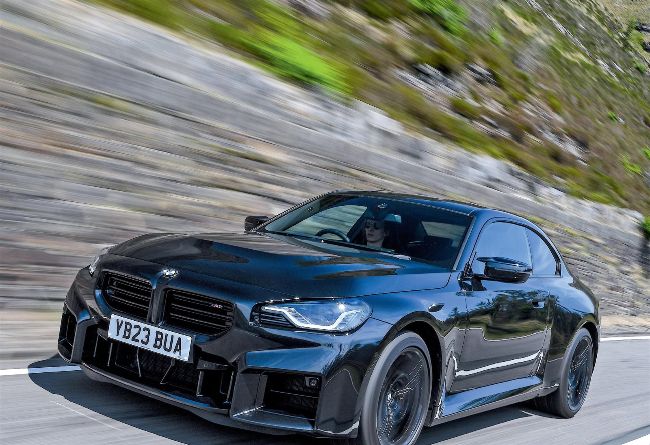
The toy-like, perfectly balanced, shrink-wrapped proportions of the BMW 1M Coupé, which the last M2 inherited to a certain extent, are now gone. From its elongated-looking bonnet to its swollen arches, burst-open front bumper and radiator grille, the new M2 has much more of the look of the modified custom hot rod or even steroidal competition car about it; it has forsaken ‘pretty’ for ‘pugnacious’. It certainly has presence, but few testers recognised as much instant visual appeal.
The M2 is 119mm longer than its predecessor, although still 214mm shorter than the M4 Coupé with which it shares many of its mechanicals. Most of that size difference – 110mm – is within the M2’s shorter wheelbase, which should influence its agility, although even that has grown by 54mm from the old M2.
The car uses BMW’s CLAR platform, now used for all of its longways-engined models from a 2 Series Coupé all the way up to an X7. Beyond that, M division elected to use as many of the proven mechanical components of the bigger M3 and M4 as it could, accepting that there would be an associated weight penalty but embracing the will to give this car as much of the performance and technical capability of a full-sized modern M car as it could – and hoping the latter would have a greater influence on the finished product than the former.