ROAD TEST No 5538
Hyundai i20 N
Our Britain’s Best A ffordable Driver’s Car winner faces its sternest examination yet
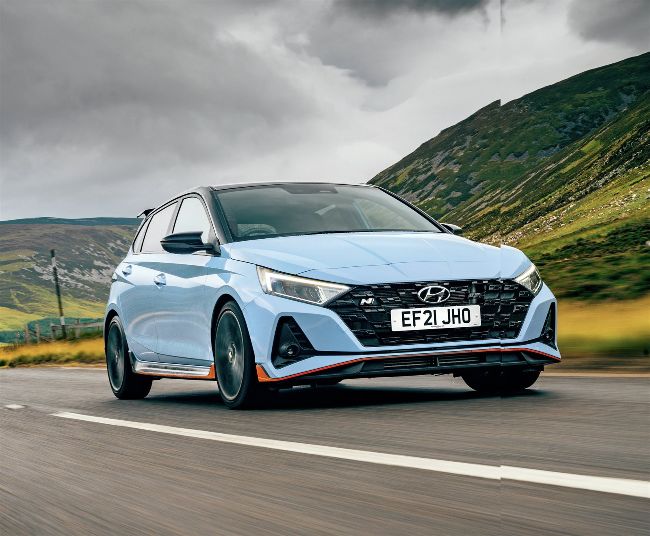
PHOTOGRAPHY OLGUN KORDAL
MODEL TESTED i20 N
● Price £24,995
● Power 201bhp
● Torque 203lb ft
● 0-60mph 6.1sec
● 30-70mph
in
fourth 8.0sec
● Fuel
economy 29.0mpg
● CO
2
emissions 158g/km
● 70-0mph 43.6m
We like
• Strong powertrain and clinical chassis give it monumental cross-country pace
• Mature cabin ambience is blended with strong driving ergonomics
We don’t like
• Engine is short of character and the handling isn’t as playful as we had hoped
• Broad array of modes for the drivetrain elements feels unnecessary
The hot supermini class – heartland of the ‘pocket rocket’ – moves in cycles of domination. For years, the Clios from Dieppe were untouchable, as Renault Sport perfected an unapologetic approach. In the mid-noughties, the Mini Cooper S, Suzuki Swift Sport and Ford Fiesta ST were all likeable alternatives, but if you were buying one of these cars for pure driving pleasure, it had to be the French one.
But with the fourth coming of the RS Clio in 2012, the magic had ebbed away, not least because the model was now automatic only. Ford, whose quick Fiestas of the post-millennium era had been fun and rewarding but unable to lay a glove on the RS Clio, picked up the mantle. The Fiesta ST introduced in 2012 had such an innate ability to entertain that even had Renault Sport released another almost perfect Clio, it still may not have been enough. In the following years, Peugeot found some form with special versions of the 208 GTi and Mini occasionally hit the sweet spot with the Cooper S, but it was never enough. Then Ford cemented its rule by decanting its near-perfect Fiesta ST over in the next generation, albeit now with one less cylinder.
It’s that three-pot Mk8 Fiesta ST – the one currently in showrooms – that you can’t avoid mentioning when talking about the subject of this week’s road test. Before 2017, Hyundai had never so much as dabbled in the art of fast hatchbacks, but the rough-diamond i30 N showed us it knew what mattered. The potential was clear. Now, with the i20 N, it wants to topple arguably the finest fast supermini of the past decade and itself be the dominant force in the class.
To that end, the i20 N has been engineered with a good degree of single-mindedness and plenty of powertrain configurability, but it also totes plenty of equipment and is practical, too. Hyundai has clearly conceived the hottest model in the i20 range to be the ultimate car of its kind, so has it succeeded?
DESIGN AND ENGINEERING
The i20 N is built at Hyundai’s Izmit plant in Turkey, using Hyundai’s own steel. In fact, the ‘built not bought’ catchphrase applies to this car more broadly than relating only to the material used to create the five-door shell, because an outfit of Hyundai’s scale and ambition doesn’t want or need to outsource much. The engine is designed and built entirely in-house, as is the six-speed manual gearbox, with its reinforced clutch, and the purely mechanical limited-slip differential that sits between the 18in front wheels, which are also made from scratch by Hyundai. The exhaust system and brakes are home-made, although unsurprisingly the tyres – Pirelli P Zeros with an i20 N-specific compound – are brought in from outside. It all adds an extra dimension of intrigue to this wild little Hyundai, because whether they choose to crow about it or not, most cars of this ilk rely on familiar names such as Brembo and Quaife.