ROAD TEST No 5618
MG 4 EV
Is the electric hatchback a good car for the money, or a good car in its own right?
MODEL TESTED LONG RANGE SE
Price £29,495 Power 201bhp Torque 184lb ft 0-60mph 7.1sec 30-70mph
6.1sec Economy 3.0mpkWh Max DC charging speed 139kW 70-0mph 55.1m
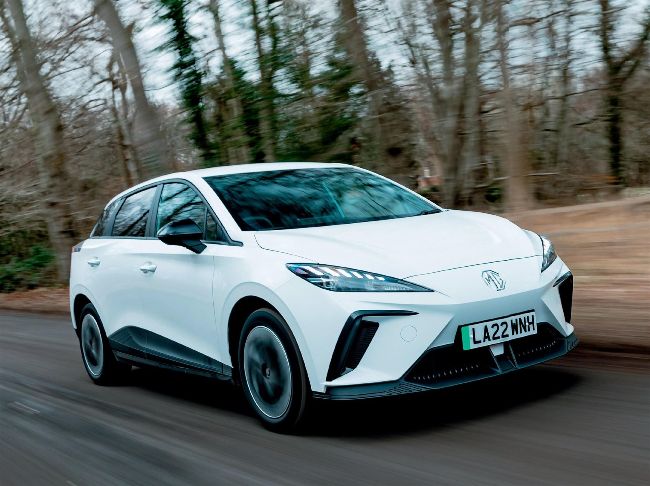
PHOTOGRAPHY MAX EDLESTON
We like
• Provides excellent value
• Offers good interior space
• Genuinely good fun to drive
We don’t like
• Driver assistance features need a lot of refining
• Interior materials don’t feel like they will stand the test of time
• Some interior usability niggles
The MG 4 represents MG Motor switching gears, which is perhaps ironic given that the sub-brand of Chinese giant SAIC has in recent years become known for selling EVs. This is something it has been rather successful at, too, thanks to long ranges and keen prices.
So far, though, modern-day MGs have been purely rational purchases, as everything other than range and price tends to be average at best and most praise qualified with ‘for the money’. In these inflationary times, there is lots to be said for value motoring, of course, but all things being equal, you would prefer a car that inspired some joy.
The MG 4 EV is different. It’s the first of potentially many good cars to come from MG. It impressed when we first drove it, and proved to be the superior electric hatchback when we tested it against the much more expensive Volkswagen ID 3 last year, so it’s high time we strapped the timing gear to it, ran the tape measure over it and dived into the tech for a full road test.
DESIGN AND ENGINEERING
★★★★☆
Unlike previous electric MGs such as the ZS and MG 5, the MG 4 was designed as a ground-up EV. It’s the first car to use the brand’s new Modular Scalable Platform, which is natively rear-wheel drive, supports wheelbases ranging from 2650-3100mm and batteries from 40-150kWh, as well as an additional front motor for high-performance four-wheel-drive versions.
The battery forms an integral part of the car’s structure and is designed to be just 110mm thick to make sure that hatchbacks and saloons actually feel like low cars.
Intriguingly, MG claims the architecture is also designed for 800V applications and to integrate with battery swap systems, such as the one that Nio is starting to roll out in Germany. For the time being, the MG 4 is less ambitious, as is only fair for a mid-sized hatchback. It sticks with 400V and is powered by either a 51kWh (50.8kWh usable) lithiumiron-phosphate battery or 64kWh (61.7kWh usable) nickel-cobaltmanganese one.
It’s also rear-drive only, thanks to a single rear motor with 168bhp in the case of the standard-range model, or 201bhp for the long-range version. In China, where the MG 4 is sold as the Mulan, the powertrain choice is a little broader, with an additional entry-level model and a dual-motor performance variant. The entry-level car is unlikely to make it to Europe, but the 443bhp four-wheel-drive range-topper probably will, as MG tries to add some sporting flavour back into its brand image. It should sit quite comfortably next to the upcoming electric roadster, previewed by the MG Cyberster concept.