ADVANCED: BOW ARM STABILITY
By Naomi Folkard and Günther Kuhr.
Keeping the bow arm stable is vital in recurve archery, but it’s surprising how quickly the strength can drop
off – especially if you’ve been out of the game for a few weeks. In this article, archers and coaches Naomi Folkard and Gunther Kuhr let you know how to keep things strong.
The shoulder is one of the more complex joints in the body. It’s sometime likened to a golf ball on a tee, but the ground on which the tee is sitting in can move! It’s worth spending a little time looking up exactly how the shoulder works; the humeral head sits on the glenoid which is formed out of the outside corner of the scapula. Bear in mind that the scapula itself is able to move in any direction and has not got a fixed resting position.
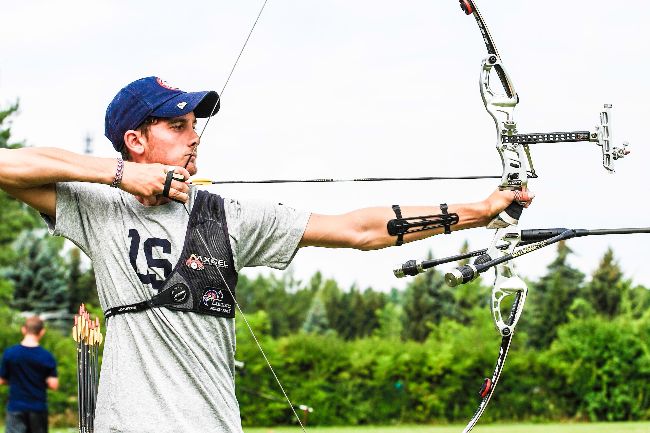
ZACH GARRETT (USA) WITH HIS ELBOW JOINT TURNED IN.
PHOTOS: GÜNTER KUHR
The shoulder is more commonly referred to as the “shoulder complex” rather than a joint because it comprises of thirty muscles, six ligaments, four major bones and tendons. It has the potential to be one of the most unstable joints in the body: there is a delicate balance between the mobility required to perform daily and more extreme tasks (sports and manual labour) and the stability required to power and stabilise the arm. Instability easily results in pain and injury due to the tiny spaces for the tendons within the shoulder structure. The requirements of the front arm in archery include achieving alignment; for injury prevention this is best done early in the shot without much stress from the draw weight. As well as alignment, the arm needs to raise, and the elbow should rotate. At full draw the front arm needs to be stable and adjust for the wind or and instability, and the shoulder needs to resist the bow both at full draw and on that moment of execution when the bow pushes into the hand.