INSULATION OPTIONS FOR SELF BUILDERS
Nigel Griffiths takes a look at the sustainability credentials of the main insulation options for your new home’s walls, floors and roof
Self builders have a great advantage when it comes to choosing insulation, as they are normally starting from a blank canvas. At the design stages, they are unconstrained by existing structures, fixed building systems, footprint size of the house or the conventional approach of a developer. In this article, we will explore different insulation materials, their advantages and disadvantages, and what their implications are for your choice of building system.
To achieve modern thermal and acoustic performance requirements, insulation must be correctly installed in all main building elements: the walls, floors and roof. Some materials are only suitable for use in one of these areas, while others can be used in all three. In practice, most projects normally have at least two different types of insulation material within them. Doors and windows are a different matter and need to be considered separately (although where they sit in the wall, in relation to the insulation, is important to minimise thermal bridging).
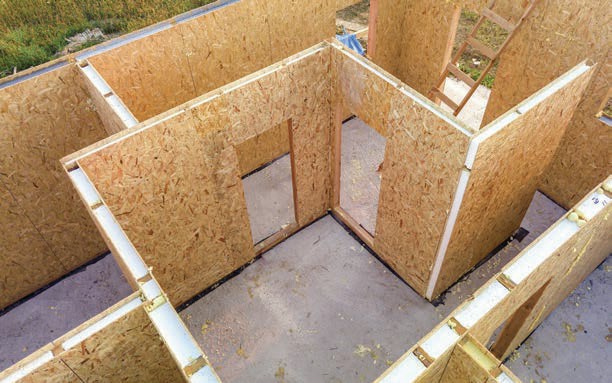
SIPs are manufactured by bonding together plastic-based foam insulation with timber sheathing to create a superstrong, highlyinsulated panel
WHAT MATTERS ABOUT MATERIALS
Your choice of building products will always come down to what your own values are. Insulation is normally hidden within the fabric of a building, so appearance doesn’t come into the equation like it does with a lot of other key products. But there are several other factors to consider:
● Sources – do you want to use renewable or natural materials?
● Embodied energy and carbon emitted during its manufacture.
● Cost and your budget.
● Structural qualities (eg compressive strength).
● Moisture resistance and how this complements the application/building fabric.
● Thickness required to achieve good performance.