project inspiration
FANTASTIC ICF HOMES
Insulated concrete formwork is an innovative structural system that can be used to create impactful architectural features and ultra-efficient homes. See what’s possible withSander Tel’sroundup of eye-catching examples
STRIKING SOLUTION
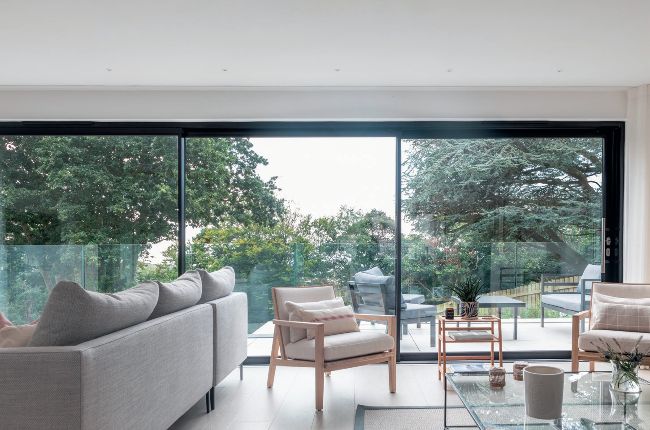
FRENCH + TYE
Built by Lilburn & Elliott construction and created using a Nudura ICF superstructure, this four-bedroom home is situated in the coastal town of Salcombe, Devon. The expansive openings were made possible with the use of a steel framed structure that was bolted to the ICF walls. The ground floor is made up of a solid concrete raft base, while the first and second floors are a block and beam construction. The shell of the building went up in just eight weeks. The house’s exterior boasts a charming blend of stone and Siberian larch cladding, with wide spans of glazing from Origin, to capture the coastal views. (www.lilburnelliott.co.uk, www.nudura .com, www.origin-global.com)
EXPERT VIEW 5 BENEFITS OF ICF CONSTR UCTION
LISA TREWIN from R-Wall takes a look at the main advantages of building with ICF
THERMAL PERFORMANCE One of the biggest advantages of building with ICF is its exceptional thermal performance, achieving U-Values as low as 0.09W/m²K. The continuous insulation layers and integral thermal mass of the concrete helps to regulate internal temperatures, providing more comfortable living environments. The lack of cavity prevents the negative effects of thermal looping, too – this is a process that reduces the insulation’s thermal performance. A recent study conducted by CLEB Laboratories has proven ICF can provide up to a 60% annual energy saving compared to a timber frame built to the same permitted code.