WHAT MAKES A GOOD SLIDING DOOR?
Discover some of the key diff erences between high and poorer quality products, with these tips on how to spot the telltale signs
If the goal of your project is to establish a seamless indoor-outdoor connection with uninterrupted garden views, it ’s likely that a set of glass sliding doors is already high on your project wish list. There are lots of factors to think about when investigating which setup will meet your aspirations best, ranging from the width and depth of sightlines, to how robustly the moving parts will per form over time. With such an enormous range of products available – some of which are much higher quality than others – it ’s impor tant to arm yourself with enough technical know-how to drill down into the nitty gritty details when you start visiting supplier showrooms. But what are the key questions to ask when you get there? More importantly, what are the giveaway signs that might indicate superior (or inferior) performance? Find out, here.
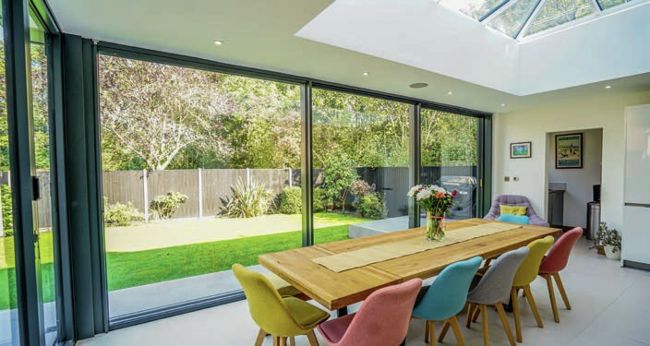
This set of sliders was manufactured by Solarlux and fitted by Thames Valley Windows, who are recognised as a Solarlux Quality Partner. This means they meet all the criteria regarding product knowledge, technical details and installation expertise
How to spot inferior systems
As the adage goes – if something is too good to be true, it probably is. This is especially pertinent when it comes to factoring the cost of high quality sliders into your project budget, as premium solutions do not come with bargain price tags. When exploring supplier showrooms, pay close attention to handles, visible mechanisms and moving parts. “If they’re plastic and cheap looking, chances are the whole system isn’t of high quality,” says Matt Higgs, managing director at Kloeber. “Look at the joint in the corners of the frames and door panels. If they look out of square, don’t line up or aren’t tight, it could be a sign of poor fabrication.”