Camera College
The complete guide to modern photography
NEW TUTORIAL SERIES
Part 3 of 9
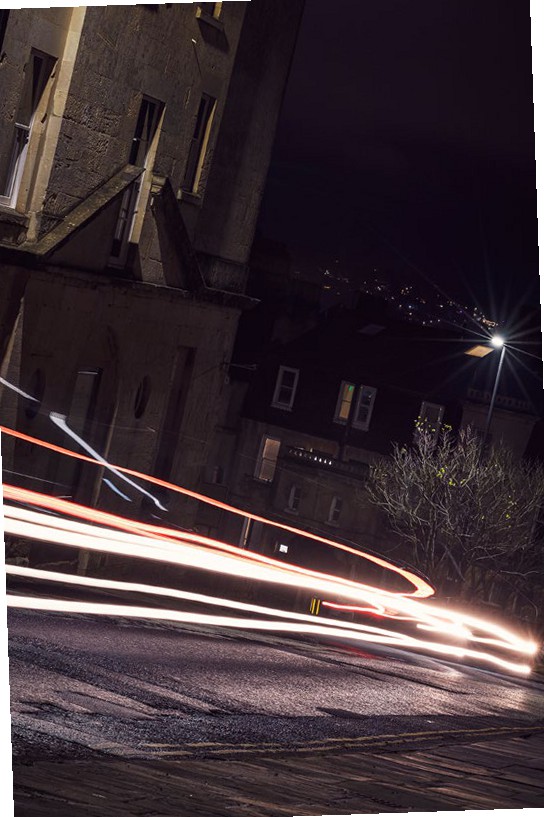
can make more balanced trail shots compared with those taken in the dead of night .
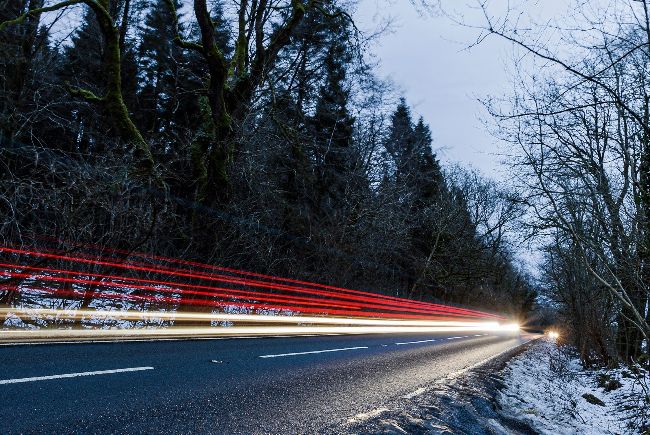
Shooting when there’s some colour in the sky
Marcus Hawkins
Photographer and writer Marcus is a former editor of Digital Camera
Let there be light trails, said the wise photographer
■ Using a long exposure to turn dots of light into sinuous streaks can transform everything from still life to the stars at night. Here’s how to get started in the art of light trail photography…
Shooting light trails is a technique anyone can try. You really don’t need a lot of equipment – any camera that gives you manual control over the shutter speed and a decent tripod to keep the camera stationary are pretty much it. The effect is simple to achieve: set a relatively long exposure on the camera, and any light source that moves while the picture is being taken will be recorded as a bright line. The longer the shutter is open, the longer the light trail will be, enabling you to turn slow-moving traffic into ribbons of colour, or distant stars into circular scratches of light in the night sky.
To record light trails, you obviously need to shoot in low light. That doesn’t mean you need to shoot in the middle of night. In fact, if you’re shooting outdoors it’s often better to do so just at the edge of darkness, when the sky still has some colour – whether that’s the cool blue of twilight or the warm tones of a fading sunset. Doing this adds some interest and makes it easier to achieve a more balanced exposure, with detail in both the landscape and the sky. You only need a subtle hint of colour: the level of low-light detail that a digital camera is capable of recording is impressive.
There are various ways in which you can set a longer exposure, depending on how much control you want to have. As its name suggests, Shutter Priority is the mode of choice when shutter speed is the most important factor. This is a semi-automatic shooting mode, where you set the length of the exposure, up to a maximum of 30 seconds (which is long enough to capture many types of light trails). The camera will then choose an appropriate aperture and ISO (if you have activated Auto ISO) to give what it determines is the optimum overall exposure. It doesn’t always get it right, so you may have to experiment with your camera’s exposure compensation function to make your pictures a bit brighter or darker, then reshoot.
Hit the road running
Turn the grind of rush hour traffic into streams of light to produce a stunning shot
■ For a classic take on light trail photography, head to a bridge above your nearest motorway or dual carriageway. The raised viewpoint will enable you to fill more of the frame with trails as the traffic streams from the foreground to the vanishing point. It also means you’ll be able to capture the white lines of oncoming headlights and red streaks from rear lights in the same frame, creating a pleasing visual balance.
It’s a good idea to set up your shot in daylight, so that you can make the most of the opportunity as twilight arrives. Shooting while there’s still some colour in the sky makes it easier to create more balanced exposures which have detail in the sky and the foreground, as well as adding interest. Light trail shots taken in the dead of night can end up looking bottom-heavy – even floodlit buildings in the scene can appear lost when framed against a stark black background, so really go to town during the blue hour or at sunset.
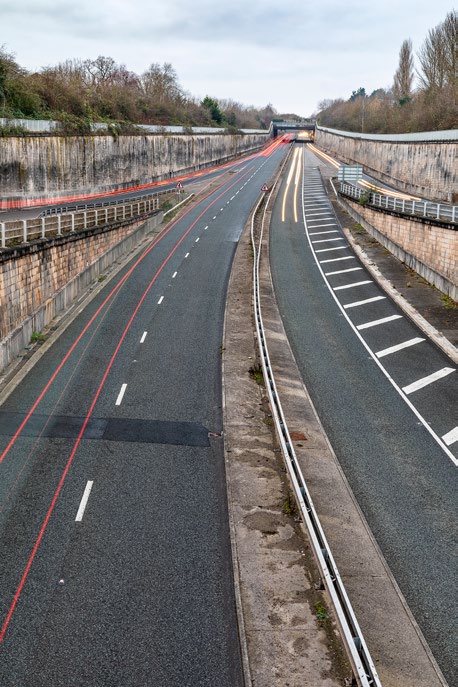
Setting up in daylight makes it easier to finalise your composition, manually preset the focus and check that there’s enough depth of field.
To ensure that all the stationary elements of your image are sharp and the light trails are smooth, use a tripod and trigger the shutter without touching the camera. You can do this using the self-timer when traffic is moving at a predictable pace. When the timing of a shot is crucial, use a wired or wireless remote release. Take plenty of shots, so that you give yourself more options when it comes to choosing and editing your pictures.
Full flowAn exposure of 30 seconds at f/16, ISO 100 gave the right level of blur, with the shot framed to emphasise the light trails.
DON’T MISS OUT! SUBSCRIBE TODAY
Get Digital Camera delivered and keep up to date with this series See page 40