DISCOVERIES
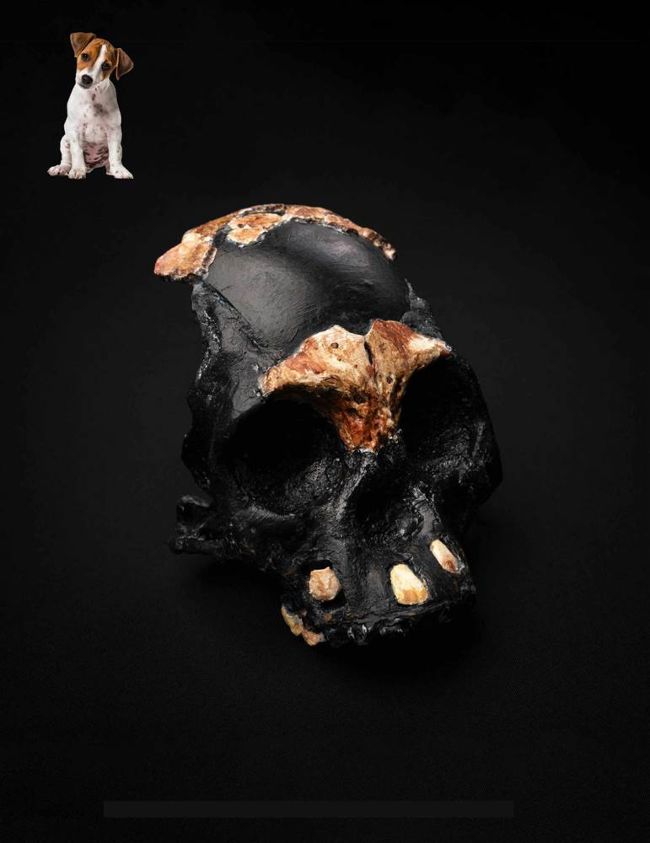
Reconstruction of the skull of Homo naledi. The dark areas are inferred portions of the skull
SHUTTERSTOCK
GOOD BOYS
Dogs tilt their heads when processing information p17
STARBASE, TEXAS
Elon Musk’s city of the future p18
GREAT SPOT!
Juno mission probes Jupiter’s Red Spot p20
ROBOT DOCTOR?
AI helps develop universal vaccines p21
ANTHROPOLOGY
SKULL FROM ANCIENT HUMAN
ANCESTOR UNEARTHED
The 250,000-year-old remains of a Homo naledi were found in the remote depths of the Rising Star cave system in Johannesburg
2021 in Science Our pick of the year’s biggest stories from the world of science and technology p22
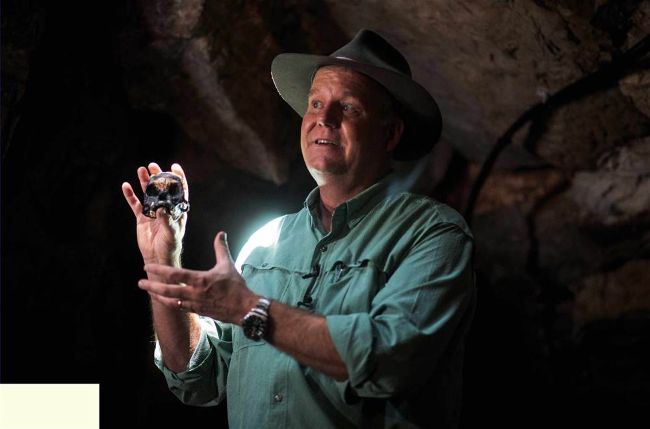
Prof Lee Berger with a life-sized reconstruction of the skull of Leti, a Homo naledi child
The partial skull of a young Homo naledi, an extinct species of hominin that lies within the Homo family tree but on a different branch to modern humans, has been discovered in South Africa. It’s the first time that a child of this species has been found.
The remains were discovered around 12 metres beyond the Dinaledi Chamber in the Rising Star cave system –a complex 2km-long network of passageways and the original site of discovery of the first H. naledi remains in 2015. They are thought to belong to a child aged between four and six who died almost 250,000 years ago.
“Homo naledi remains one of the most enigmatic ancient human relatives ever discovered,” said Prof Lee Berger, project leader and director of the Centre for Exploration of the Deep Human Journey at Wits University, and an Explorer at Large for the National Geographic Society.
“It is clearly a primitive species, existing at a time when previously we thought only modern humans were in Africa. Its very presence at that time and in this place complexifies our understanding of who did what first concerning the invention of complex stone tool cultures and even ritual practices.”
The researchers have named the skull Leti, which means ‘the lost one’ in Setswana, one of South Africa’s 11 official languages. It was reconstructed from 28 skull fragments and six teeth and joins almost 2,000 other individual fragments belonging to more than 20
H. naledi individuals unearthed in the Rising Star cave system since its discovery in 2013.
“This makes it the richest site for fossil hominins on the continent of Africa and makes H. naledi one of the best-known ancient hominin species ever discovered,” said John Hawks,a biological anthropologist and lead author of a previous study on the fossil skeleton of a male H. naledi, nicknamed ‘Neo’, that was also found at the cave.
“It is likely that other members of its species transported it to such a remote location”
Leti’s remains were discovered in a claustrophobically tight passage that measures just 15 x 80cm. Although the skull was found in many fragments, there are no obvious signs of injury, so the researchers are unable to speculate on how Leti died.
There are also no signs of damage from carnivores or scavengers and no evidence of the skull being washed into the narrow passage by flowing water. This makes it likely that other members of its species were involved in transporting it to such a remote location.