FLYING ON EAGLES
Gregory Kulon looks back at War Eagles, the famous unmade 1939 Technicolor fantasy film about Vikings riding giant eagles, and fighting Nazis over New York!
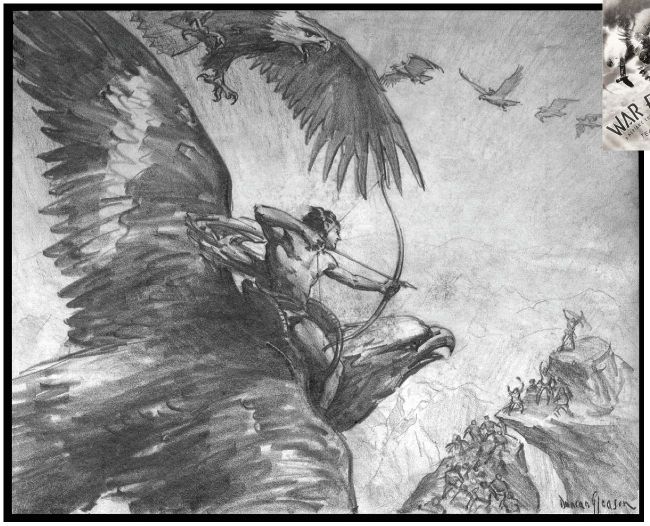
Main image: J. Duncan Gleason art for War Eagles. The poster art shown on upper right is a poster created in 2011 by Dave Conover for his excellent book War Eagles: The Unmaking of an Epic
When you have already created something that spread across the world like a virus and became iconic in only a few years, something with fantastic imagery, exhilarating action, and an emotional heart, how do you top it?
Such was the problem that Merian C. Cooper confronted for a large part of his career after he produced and co-directed the original King Kong (1933). His future career would include many Hollywood classics, a prominent military role in World War II, executive positions at aerospace companies, and even a personal Oscar. But in 1937, he was still trying to top that emotionally charged finale with the giant ape holding his beauty while fending off a squad of airplanes from the top of the highest perch in civilization. Fortunately, Cooper had an idea of something that might be able to do that, but could he make it happen?
In June of 1937, Cooper joined what was considered to be the pre-eminent movie studio, with the resources to pull off incredible productions with depth and style. He hoped the resources at Metro-Goldwyn-Meyer (MGM) would be the answer to his dilemma.
COOPER’S PITCH
The project that would eventually be known as War Eagles would become one of the most talked about “what if” projects among fantasy film and stop-motion animation fans for decades.
The known history of the project starts with a pitch prepared by Cooper for MGM executives. Titled White Eagle or War Eagles, and dated September 20, 1938, the nine-page pitch, based on Cooper’s own idea, describes his “super Western of the air in which, instead of riders of the plains on horseback we will have wild riders of the air on giant prehistoric eagles.”
His great showmanship spectacle scene, which he compared to Kong on the Empire State Building, “will be a terrific battle in the air over New York, between hundreds of our eagle riders and squadrons of enemy airplanes which are attempting to bomb the city.” Here he had a project that could top Kong in spectacle, build on his knowledge and love of aviation, and capture Cooper’s sincere feelings of patriotism
Cooper describes his “central character” of the plot as “the Tom Mix-Tony combination. It will combine our hero, an American ex-Aviator, and his steed -the great, beautiful, fighting White Eagle.” His pitch would note that “This great White Eagle will stand out visually at all times against the brown and black colour of the other eagles.”
The story starts with the unnamed hero, a great but impulsive aviator, being discharged from the army after pulling a reckless stunt. Looking for something to do, he decides to fly solo around the world on a polar route. The plane crashes in an unknown and warm volcanic valley surrounded by mountains where he sees a beautiful woman flying a giant eagle. He is soon beset by a prehistoric beast that begins tearing at the plane to devour the young aviator. Other natives astride eagles battle the beast, killing it with spears and arrows. As more of the beasts arrive, the aviator is rescued and taken to their refuge midway up the mountain cliffs.
The aviator learns the ways of the eagle riders and even how to ride the eagles. As time passes, he falls in love with the war chief’s daughter. To survive, the Vikings travel on their eagles to a dangerous valley to secure food. This lush valley is populated with prehistoric beasts and a race of ape men. Women of the bird people are sacrificed by the ape men in arena like games that pit them against prehistoric beasts.
On one of the food foraging expeditions, the aviator’s young love is captured by the ape people. As part of the sacrificial game, she is suspended by ropes and swung over a hungry Allosaurus. As generally expected for this type of tale, the aviator rescues the girl and kills the leader of the ape men in a series of ‘outstanding adventures” to be detailed later.
On his wedding night, the aviator turns on the radio from the wreck of his plane to surprise his new bride with music. However, all they receive is news of the US President describing a foreign air fleet armed with a weapon that neutralizes its enemies’ engines, making their planes useless. If the US does not surrender in 48 hours, this foreign fleet will destroy New York City.
Recognizing that the eagle riders might be the only hope to save his country, the aviator convinces his new friends to help him defeat this enemy. Armed with primitive bombs, the group of eagle riders subdue the foreign fleet in an epic battle over the city. The film ends with the aviator astride White Eagle, overlooking the city they have saved from atop the Statue of Liberty.
Clearly, this new project had the possibility of being a pure spectacle if Cooper could pull it off. It was also something vastly different than the types of projects for which MGM was generally known. However, to be fair, this project was not like anything any studio had ever tried before. Somehow, Cooper convinced the executives to go forward with pre-production on the project. First, he had to refine the story and pull together some footage proving that what he intended to put on screen could be accomplished.