KORN
YOU CAN’T KILL KORN
Death, disease, paranoia and an absent Fieldy… and that’s all just in the past few years. Almost three decades in, Korn remain as turbulent as ever. But has kickass new album Requiem helped them finally turn a corner?
WORDS: PAUL BRANNIGAN
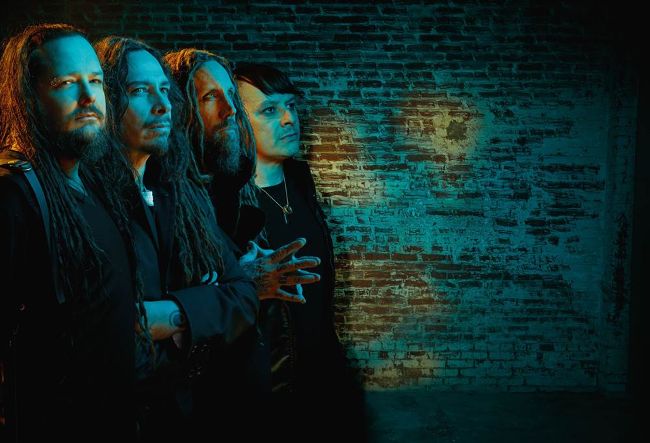
PICTURES: TRAVIS SHINN
“Around the time of my father’s death, I had severely slipped into bad drug use and alcoholism. I had lost both my parents now, and I didn’t want to deal with it, didn’t want to face it. I had a beautiful house by the beach, and I basically barricaded myself in, with all the windows blacked out, and turned music up really loud in every room. It was a very quiet neighbourhood until I moved in, so my neighbours must have been like, ‘This motherfucker, we can’t take this anymore…’
“So, one day this policeman knocked on my door, at like 6am, as the sun was rising. He asked if I had any guns in the house, and I responded, ‘If I do have any guns, you will be the first to know’, and slammed the door in his face. And about 15 minutes later, I had a SWAT team outside my house…
“They got me out and arrested me, and they knew I was not OK: they could obviously see, like, ‘OK, not only is he high, and drunk, but he’s mentally unstable.’ I woke up handcuffed to a hospital bed in a psychiatric ward, on hold for 72 hours. And that was the moment where I was like, ‘I can’t go on like this…’”
It’s 11pm in Los Angeles, in the middle of the second week of January, and James ‘Munky’ Shaffer is in his stylish downtown studio/man cave, all exposed red brickwork and gleaming chrome pipes, a safe, tranquil space to which Korn’s 51-year-old guitarist gravitates whenever what he describes as the “chaos” of family life with three young children threatens to become overwhelming. As he shares the anecdote above, one is reminded that his use of the word “chaos” here is relative, obviously.
“In the 90s, our attitude was, ‘Fuck tomorrow, we’re living today!’” the guitarist admits, laughing warmly as he settles in for a 30-minute Zoom call. “Sometimes I can’t believe… wait, let me knock on this chair, because it’s wood… sometimes I can’t believe we’re alive. If my neighbours hadn’t called the cops on me that day, or maybe if I’d been living out on my own in acres of land instead of by the beach, I’d probably be dead.”
“We were definitely not smart back then,” agrees Brian ‘Head’ Welch, Munky’s friend since “eighth or ninth grade… basically forever”, and the co-creator of a game-changing, signature guitar sound that redefined heavy music in the mid-to-late 1990s. “We thought the Mötley Crüe story was a blueprint for life, and we followed it religiously. When you’re young and dumb, you can live like that for a time, but sooner or later it will ruin your life. And it did, it surely did.
“But we all got a second chance,” Head says quietly. “And sometimes I think, why were we the lucky ones? Why did we survive? Because if you think about Slipknot, and Avenged Sevenfold, and Deftones… so many bands have lost someone. And I’m just grateful, so very grateful, to see my friends healthy and happy now, still doing what we love. It’s amazing.”