Masterclass
MINI MARVELS
Looking at railways in detail
As one of the smallest British standard gauge locomotives ever built, Ruston’s tiny four-wheel diesels have long been a source of fascination for modellers. Ben Jones discovers more about these cult industrial machines and their surprisingly long career.
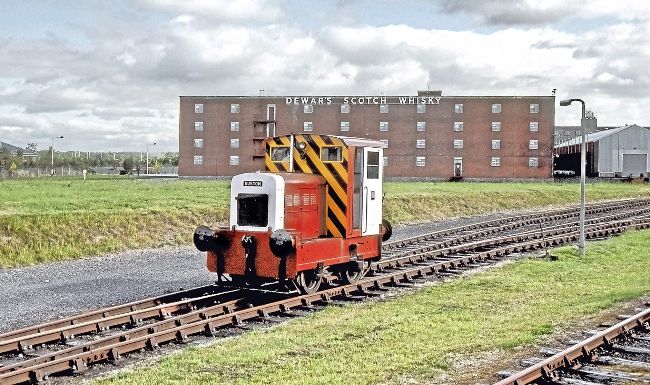
One of the final ten locomotives built, an immaculate No. 458957 of 1961 poses outside John Dewar’s whisky warehouse in Perth on September 2 1993. Now preserved at the Caledonian Railway in Brechin, it is a fine example of a late 48DS with an enclosed cab and deep bufferbeam.
GORDON EDGAR
It’s tempting to think of internal combustion engine locomotives as a relatively recent development, but the world’s first railway locomotive with an ‘oil engine’, as they were once called, was built by Priestman Brothers of Hull as far back as 1894.
This rudimentary four-wheel standard gauge vehicle had a vertically mounted twin-cylinder 12hp marine engine driving the wheels via a crankshaft and large flywheel. It was tested by the Hull & Barnsley Railway at Hull’s Alexandra Dock although it was limited to hauling just one wagon – a forerunner of the thousands of small shunting locomotives that would be built for industry in the following century.
In the late 19th and early 20th centuries, oil engine locomotives were limited to small industrial and narrow gauge types, due to their low power. However, over the next two decades, as internal combustion engine technology improved, the locomotives steadily increased in size and power.
The remarkable longevity of the design hints at its popularity and versatility
Their development was accelerated by the necessities of the First World War, which introduced petrol and diesel vehicles to the battlefield, including the famous Simplex field railway locomotives. Throughout the 1920s, many machines were proposed and built, although they remained relatively small and low-powered by modern standards. However, they proved useful for narrow gauge, industrial and export applications.
LEADING LIGHTS
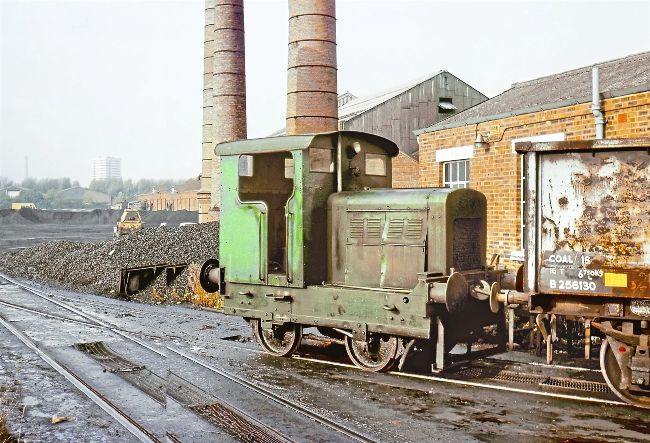
Demonstrating the kind of work for which the 48DS was built, No. 224346 stands with a BR 16t mineral wagon within British Leyland’s Coventry factory on October 27 1976. The unmarked locomotive was delivered to Morris Motors in March 1945 and still carries standard Ruston &
Hornsby factory green.
A leader in this market was Lincolnshire engineering firm Ruston & Hornsby (R&H). R&H was founded in September 1918 as an amalgamation of two long ‐established Lincolnshire engineering companies – Ruston, Proctor of Lincoln and Grantham’s Richard Hornsby & Sons. Both had played a pioneering role in the development of internal combustion engines for industrial and agricultural use.
Ruston’s started building oil engines in 1897, and by 1900 it was exporting all over the world. From 1933 onwards, the R&H product range expanded to include more powerful locomotives and a range of gauges, yet small shunting ‘tractors’ designed for industrial use remained at the core of its output.