Masterclass
Making tracks
Based on a standard industrial design, the Western Region’s small fleet of Permanent Way Machines (PWMs) were a rare ‘cop’ for many enthusiasts. Ben Jones discovers more about these elusive little diesels.
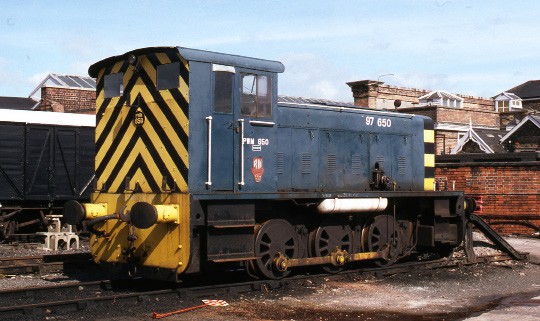
BR’s prototype Ruston & Hornsby ‘165DE’, 97650 (ex-PWM650), carries both pre and post-TOPS numbers atop its faded Rail blue livery, at Taunton Yard in March 1981. Note the smaller wheels and cab windows of this unique locomotive, along with a different roof profile and other minor differences to PWM651‐4.
COLOUR RAIL
Looking at railways in detail
Tucked away at the back of your Ian Allan Abc, the Western Region’s fleet of five Ruston & Hornsby Permanent Way Machines (PWMs) were a rare anomaly in the British Railways locomotive fleet. PWM650‐654 were never allocated to the revenue‐earning fleet, instead they were acquired to work in civil engineering possessions, moving track panels and bridge girders or shunting at engineers’ depots.
Although they were allocated to only a small number of PW depots across the Western Region and allocations were relatively stable, they were often difficult to spot from passing trains, making them a rare catch for many spotters, especially those of us visiting from further afield. Spotting a ‘PWM’ and underlining it in your book could be a significant ‘cop’.
For many, they became even more ‘rateable’ when they were painted yellow in the 1980s, marking them out from the common herd of scruffy blue shunters. It also made them easier to spot from a distance when you were passing Reading or Taunton. In the days of BR blue Class 03s and 08s, the Western Region’s small fleet of exotic departmental shunters was an interesting break from the norm elsewhere on the network.
Generally the ‘PWMs’ led a low-profile existence, carrying out their essential engineering duties largely out of the public eye
Famously, Reading Signal Depot was home to ex-Scottish Region Class 06 97804 and R&H ‘88DS’ 4w ” diesel No. 20 (later 97020), but the ‘PWMs’ were unusual – a conventional industrial design purchased as on-track plant, rather than a general user locomotive.
PIONEERS
But first a little background. Ruston & Hornsby was founded in September 1918 as an amalgamation of two long‐established Lincolnshire engineering companies – Ruston, Proctor of Lincoln and Grantham’s Richard Hornsby & Sons. Both had played a pioneering role in the development of internal combustion engines for industrial and agricultural use.
Ruston started building oil engines in 1897 and by 1900 it was exporting them all over the world. Fuel injection and cold starting oil engines were introduced by Ruston in the 1900s.