REAL GONE
Who Will Save The World?
Tony McPhee, one-of-a-kind guitarist, lyricist and leader of the Groundhogs, left us on June 6.
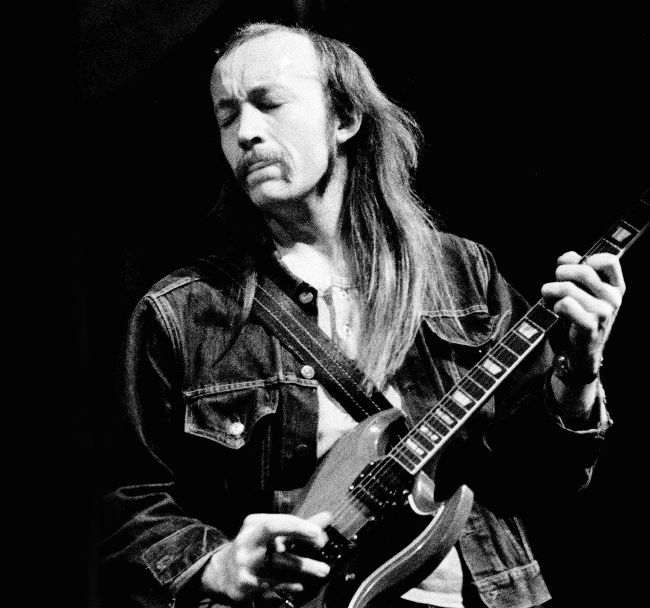
Thank Christ for the Groundhogs: Tony McPhee, loudly rejecting orthodoxy on-stage in Copenhagen, 1973.
Getty (2) Alamy
LEGEND SAYS that in their prime the Groundhogs, led by Tony McPhee, received consolatory letters from the Guinness Book Of Records. These informed them they were the secondhardest touring band after Jethro Tull, and the secondloudest band after Deep Purple. If the Groundhogs’ standing today is more modest than their more famous peers, however, McPhee’s legacy is every bit their equal.
“Hendrix… projected electric frustration.”
TONY McPHEE
Born in Lincolnshire on March 23, 1944, and raised in Streatham, the teenage McPhee was thrilled by Cyril Davies & The All-Stars, and played rock’n’roll and blues by night after working for the Post Office. A connoisseur blueser, in 1963 he founded the Groundhogs alongside bassist Pete Cruickshank. They were named for Ground Hog Blues by John Lee Hooker, who the band would back on his 1964 UK tour; they did the same for such visiting blues greats as Jimmy Reed, Champion Jack Dupree and Little Walter. With the British blues boom waning, McPhee disbanded the group in 1966 for other projects, including the poppier Herbal Mixture, and then the John Dummer Blues Band.
Yet, with freer blues developments in the air, McPhee reconvened the Groundhogs in 1968 and signed to the new, happening Liberty label. If 1969’s Blues Obituary was an explicit rejection of orthodoxy, the new decade’s Thank Christ For The Bomb struck out into new territory, examining class, the futility of war and the existential threat of the nuclear age, with supercharged riffs. With John Peel’s support, a new, ear-splitting PA system for live dates and a tour opening for The Rolling Stones, it reached UK Number 9 in summer 1970. Remarkable, schizoid follow-up Split peaked at Number 5 in March 1971, shortly after which McPhee reflected on his admiration for Hendrix to Record Mirror: “Hendrix was one of the greatest blues guitarists ever because he projected just that kind of electric frustration – after listening to him you felt you wanted to go out and break something.” Throughout this successful period, the hard-gigging group remained modest in their tastes. As well as eschewing catering for the local fish and chop shop, the man the music weeklies called ‘Mac’ relaxed on tour by re-soldering his guitar pedals.
1972’s eco-concept Who Will Save The World? The Mighty Groundhogs hit Number 8 a year later. Further proof that the trad blues were way back in the rearview mirror, it displayed McPhee’s growing interest in synthesizers. It was also their commercial peak. Their new management team was headed by one Wilf Pine, whose 2003 biography was entitled One Of The Family: The Englishman And The Mafia. He got them to America, but after McPhee broke his wrist in a horse-riding accident in Pennsylvania in summer 1972, momentum was lost, with drummer Ken Pustelnik leaving the classic line-up.
Remarkable music still followed, including 1972’s hard, progressive Hogwash and ’73’s blues/synth cri de coeur The Two Sides Of T.S.(Tony) McPhee (credited to McPhee solo, the ‘T.S.’ stood for ‘Tough Shit’). After another split and reconfiguration, however, the band were laid to rest in 1976. McPhee continued to lead new Groundhogs formations and record solo, with the occasional hiatus, while the classic line-up reunited to tour in 2003. In 2009 he suffered the first of several strokes but kept on playing, most recently, in 2015, with Current 93.
McPhee thought it was “weird” that he had fans from the punk-and-after milieu. These included Karl Hyde, Captain Sensible, Stephen Malkmus, Queens Of The Stone Age and Mark E. Smith, who miscredited McPhee as ‘Tony McFree’ when covering Junkman in 1994. McPhee’s wife Joanna thanked his admirers for their words of tribute, saying, “he would have been made mighty indeed by the love and recognition.”