Herpetological Mysteries
Unravelling the truth
Dr Karl Shaker focuses close to home in his regular column this month, highlighting three cases of accounts of mystery animals reported from the British Isles across the centuries, which help also to reveal the processes involved in determining whether or not such creatures might actually exist.
Photo courtesy Sharon Harper/
www.shutterstock.com
The Loch Ness monster is undoubtedly the most famous British mystery beast (or ‘cryptid’) for which various herpetological identities (among many others) have been offered, including those of a giant salamander, an enormous frog, and a surviving species of plesiosaur - a type of marine reptile which is generally regarded as having died out with the dinosaurs, around 66 million years ago.
Yet there are also other, far less famous cases of cryptids that have been reported from various parts of the UK and could also be some type of reptile or amphibian – always assuming that they actually exist to begin with, of course! So here are three of these rather more obscure but no less fascinating anomalous animals of a (potentially) herpetological type to consider, with each of them having a very different background.
The return of the walking fir cone
In 1997, I featured one of the strangest modern-day reports of a mystery animal from the British Isles in my book From Flying Toads To Snakes With Wings. Here is what I wrote about it:
“Equally as incongruous…is a scaly anteater (pangolin) abounding in England, but how else can we explain the baroque beast encountered in Dumpton Park, Ramsgate, Kent, on April 16, 1954, by Police Constable S. Bishop, and described by him as a "walking fir-cone"? This is an excellent description of a pangolin, those insectivorous mammals covered in huge scales remarkably similar to those of a fir cone or pine cone.
“Pangolins, however, are wholly restricted to the tropics of Africa and Asia. Also, they are so difficult to maintain in captivity that they are seldom exhibited in zoos, and hardly ever kept as pets. So even if we do identify PC Bishop’s beast as a pangolin, how can we explain its presence in a Kent park? We have simply exchanged one mystery for another, and emerged none the wiser.”
Courtesy of the author.
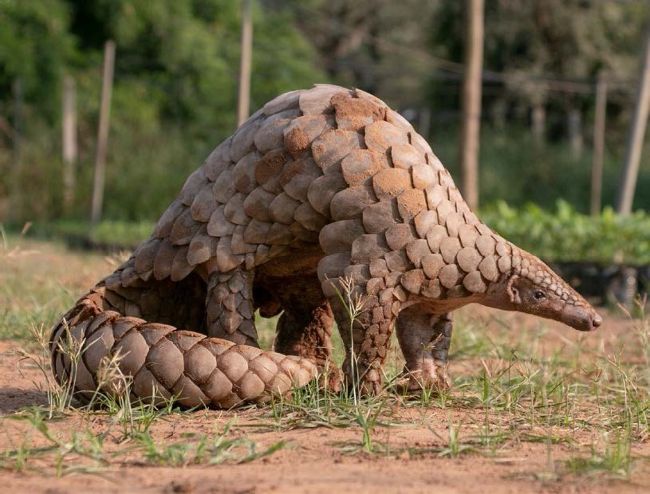
An example of a pangolin. This is the Indian species (Manis crassicaudata).
Photo courtesy Vickey Chauhan/
www.shutterstock.com
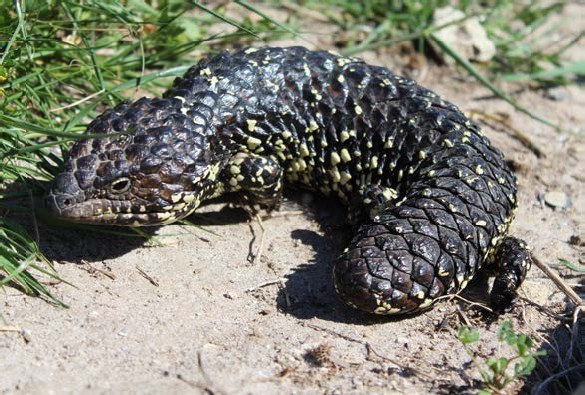
A shingleback lizard looks decidedly like a pine cone, and could be a more realistic option for the creature’s identity than a pangolin.
Photo courtesy LCAT Productions/
www.shutterstock.com
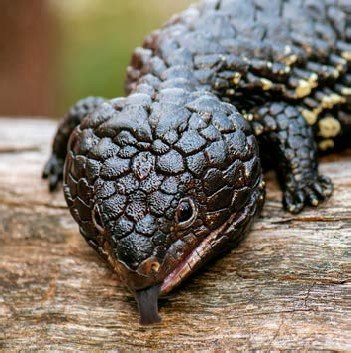
The tail of these lizards is shaped very similarly to their heads, as a way of confusing would-be predators.
Photo courtesy robdowner/
www.shutterstock.com A new identity?
Subsequently, on June 3rd 1999, however, I received a very interesting e-mail from a reader, John Mitchell of San Francisco, in California, USA. Having greatly enjoyed reading about PC Bishop’s 'walking fir-cone' in my book, John wished to nominate what may indeed be another candidate for this odd beast’s identity. He wrote: