This Creeping Malaise
Few albums from the 70s have such relevance today as Animals. It captured the moment when Pink Floyd made the giant leap from lush to harsh, from a pillow of winds to cold shafts of broken glass. Although some fans missed the expansive soundscapes of its predecessors, its lyrics tore into the evils of capitalism and abuses of power and seem even more apposite today than at the time. Prog explores the ugly beauty of Floyd’s 10th studio album.
Oink Oink: Daryl Easlea Image: Hipgnosis/Storm Thorgerson/Aubrey Powell/Pink Floyd Music Ltd
I
n the long, hot summer of 1976, Pink Floyd were holed up in their brand new studio in Islington making what would become their 10th studio album, Animals. Ten years earlier, they had been the sound of the underground and soon began making their name on the London scene. Thanks to 1973’s The Dark Side Of The Moon, Pink Floyd had become the biggest underground band in the world. And, now, as the establishment themselves, they were old news. Britain was in the grip of industrial unrest and a drought that seemed to provide a metaphor for the lack of direction in the country. Far-right groups were stirring, punk rock was emanating from the children of those who’d welcomed Floyd a decade earlier. With one eye looking over his shoulder, Roger Waters wrote a Pink Floyd album that remains discrete within their catalogue even today. Released at a time when anything more than a three-minute, three-chord thrash was an early candidate for cancel culture, Animals stands as odd and as proud as those four thrusting chimneys on the cover.
Even today, for an album with such a well-known, iconic sleeve, comparatively few know the music within. Given that the group had already attained megastar status, it was a difficult album to promote, aside from the fact it was by Pink Floyd and they promoted themselves. With three pieces all over 10 minutes long, there was no track to take to radio. Even in the US, where singles had repeatedly been taken from albums, they knew the game was up, and had nothing to offer. Just how did a group that had the world at its feet come to make quite such a bitter, idiosyncratic record?
“I don’t think the humour of the work has ever really escaped in the way it might have.”
Roger Waters
The roots of An imals lay in Pink Floyd’s 1974 British Winter Tour. It was here that the band debuted the two grim, lengthy songs they’d rehearsed in that windowless room next to the Wimpy Bar in King’s Cross earlier that year, that sat with their other newie, then known simply as Shine On. Whereas Shine On seemed warm and poetic, You Gotta Be Crazy and Raving And Drooling bordered on the atonal. The former had the lyrics: ‘Gotta keep all of us docile and fit, gotta keep everyone buying this shit’, while the latter stated: ‘How does it feel to be empty and angry and spaced, split up the middle between the illusion of safety in numbers and the fist in your face?’ Their sole purpose seemed to be to harsh their audience’s mellow.
Nick Sedgwick, Roger Waters’ friend who toured with the group in the early 70s and wrote the memoir In The Pink, captures the London in which the Floyd were rehearsing. It was a time of unemployment, inflation, and IRA bombings. Britain, not for the first time, nor the last, appeared to be going to hell in a handcart. “Everywhere was grey, sodden, and above all else, cold,” he wrote. “A kind of gloom set in: a languorous melancholy, which seemed exactly commensurate with the prevailing rhythm of the national psyche.”
The mood of despondency in Pink Floyd was exacerbated by the regional tour that followed. The band visited Stoke-On-Trent’s crumbling pleasure palace, Trentham Gardens, on a Tuesday night in November 1974. “What the fuck are we doing playing in a building like this?” Waters said on seeing the hall. “We really should stay in one place. It would be more expensive for the kids, what with train fares and the rest, but we’d do much better gigs.” The dissatisfaction, that is commonly seen as setting in three years later, was already taking hold. Sedgwick captures the creeping malaise perfectly: “I watch Dark Side Of The Moon from the stage, though off to the side and from the audience… Amazingly, one of the crew is asleep on a pile of cables. Hard to credit what with the noise and the heat, and the girls urging the crowd to clap along, and Dick Parry busting a gut in Money and the boys so close you can see the beads of sweat burst from their brows. But you can even grow used to magic when there is enough of it.” By now, the Floyd had grown used to everything. And this was the root of Animals.
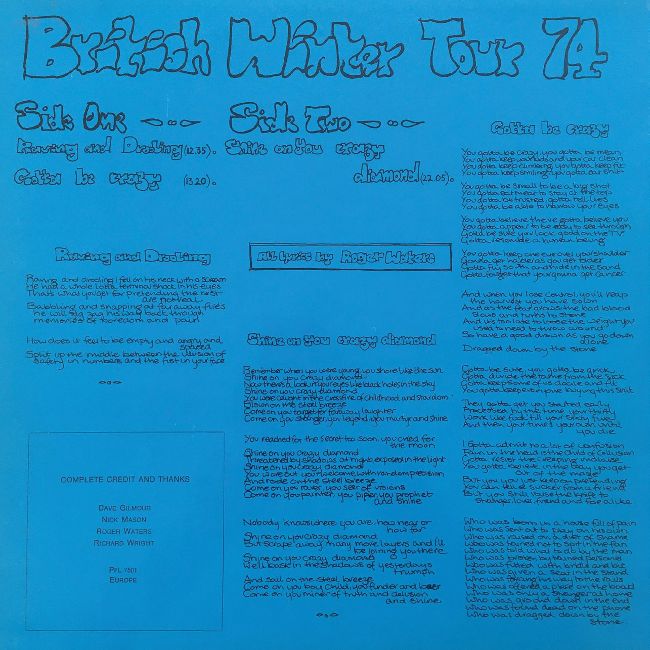
The back cover of the sleeve of the Winter Tour bootleg showing earlier lyrics (presumably as heard by the bootlegger) of Raving And Drooling and Gotta Be Crazy [sic].
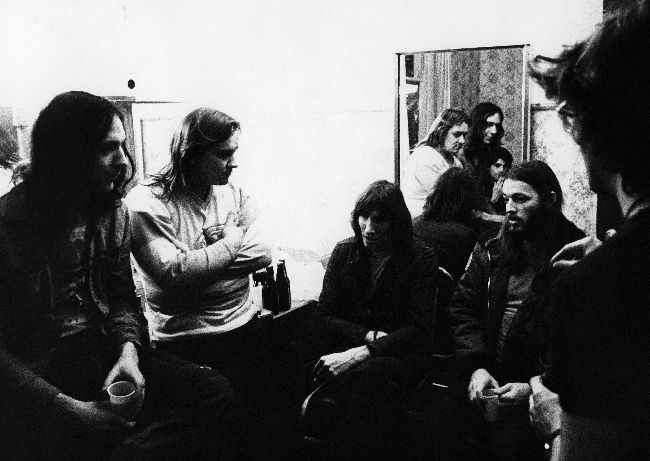
Cramped conditions backstage on the British Winter Tour. Robbie Williams, Mick Kluczinski, Roger Waters, Rick Wright (visible in the mirror) and David Gilmour.
MICK GOLD/REDFERNS/GETTY IMAGES