JETHRO TULL
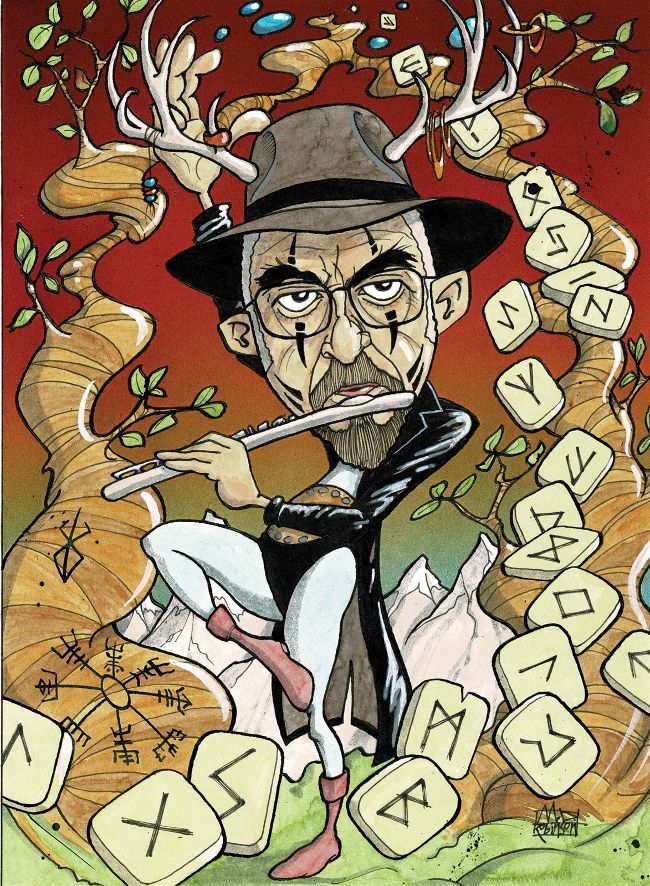
Ian Anderson draws on Viking mythology on the follow-up to The Zealot Gene – but no one’s living in the past on Tull’s 23rd album.
Words: Sid Smith Illustration: Michael Robinson
When Ian Anderson began treading the boards in the early 1960s, there was never any expectation that bashing out a few blues standards could lead to something like a proper career. Pop stars came and went – even The Beatles thought all the fuss would blow over soon enough. If they were lucky they’d make a few hits, meet a few stars, have a few laughs and bank a few stories to tell the customers frequenting the shop they’d probably open in their settled-down post-pop life.
Well, that might have been the theory back then but somebody must have forgotten to pass the memo on to Anderson. Driven by a fearsome, unrelenting work ethic for more than half a century, the singing flautist and the current incarnation of Jethro Tull are back with their 23rd studio album, RökFlöte.
As with his readings around the tenets of Christian religion on The Zealot Gene and before it Homo Erraticus’ criminally underrated consideration on the interaction between migration and culture, RökFlöte is an extended study of a particular subject that’s hooked Anderson’s attention in the past. Mythology, legends and humankind’s deep connection to the pagan Earth itself have all been fertile ground for artists from all disciplines, and over the years Anderson has tilled more than his fair share of important plots in that particular field. Beltane, Dun Ringill, Kelpie, Jack In The Green, A Cold Wind In Valhalla and other numerous folkloric touchstones stand out in the Tull landscape.
RökFlöte’s 12 songs dig into the pagan realm of the Norse gods and the medieval Viking culture that sought their blessing deeper than ever before. At one level it’s an ancient world long gone and far removed from our modern life. Yet vestigial bonds of connection continue to thread themselves into present times through the days of the week: Tyr, Wōden, Thor, Freya – or Tuesday, Wednesday, Thursday and Friday, for those who prefer to anglicise the old gods. Anderson goes far beyond such a largely superficial example and one gets the sense that he’s never happier than when researching, burrowing deep and wide into a subject, spurring him on as much as writing the music.
"It resounds with personality, meaning and drama."
Here, Ginnungagap, Hammer On Hammer and Wolf Unchained all bear the hallmark of classic Tull, hovering somewhere between a metallic-clad cèilidh band with attitude and a professorial chamber rock ensemble delighting in their rhythmic and textural complexity. That is, one could imagine all these tunes being a welcome and substantial all-killer-no-filler addition to the live setlist at almost any point in the band’s history. With all the band pulling their weight, it’s nevertheless worth mentioning that guitarist Joe Parrish-James’ catalysing presence is especially good throughout as he builds slabs of heavy duty riffage on the monumental Wolf Unchained. His whirlwind solo spectacularly builds to a tail-spinning frenzy that’s underpinned by John O’Hara’s gothic-edged keyboards, producing an impressive and thrilling conclusion. The ability to switch between that kind of savage lyrical articulation and the spiky foundational chord structures deftly articulates the balance that’s been wired into Tull’s modus operandi since Stand Up.
Of course, Anderson is the overarching presence. The limitations of his vocal range are evident as they have been for several years now. That rapier-like voice that’s been central to Tull’s cut-and-thrust dynamic has undeniably and understandably thinned, as with a vocal bandwidth that’s been dulled and narrowed by age and health. Always a practical and pragmatic player used to problem solving, over time he’s evolved a conversational approach to his lyrics that are infused with a nimble intimacy, enabling him to carry the material with his customary authority. Aside from his voice, the signature sound of the record is, as always has been, the flute. His instrumental capacity, with its increased precision and lyrical concision is as dextrous and as vibrant as it has ever been.
Where does RökFlöte sit in the Tull canon? Let’s rule out fatuous ‘it’s not as good as Aqualung’-style proclamations. Instead, one looks to compare the writing and performance with the latter-period repertoire. Coherent and confident throughout, with a collection of songs resounding with personality, meaning and drama, it feels and sounds like a band that’s moving forward.
At 75 years old, Anderson is entering the final stretch of a remarkably productive career. It’s to his credit that he can produce music of this quality and calibre. Tull aren’t a band living in the past but one that firmly occupies the here and now, with Anderson, like the Allfather himself, towering over the very centre of it all. Long may he continue.
AMPLIFIER
Hologram ROCKOSMOS
Mini album from stargazing Mancunians that bridges a six-year gap.
The pandemic derailed the plans of plenty of bands, and Amplifier’s momentum seems to have been slowed more than most. While frontman Sel Balamir put out two low-key solo albums recently, there’s been a six-year interval between his main band’s last album, 2017’s Trippin’ With Dr Faustus, and this follow-up teaser.
There’s been no obvious attempt to rethink their robust, psychedelically charged power prog sound, though, and on reading the accompanying promotional material, there’s the sense that they’re doubling down on a musical approach that they see no reason to redirect. They talk of their journey as a band since their 1999 formation “without ever compromising our integrity, dedication to the rock and maintained the eternal pursuit of the most excellent riff”.
That’s surely for the best, as they do an impressive job of playing to their many strengths here. Balamir and drummer Matt Brobin make their creative presence felt on the opening track, Two-Way Mirror, which reinforces the former’s sludgy, stoner-leaning riffs and unorthodox chord progressions with the latter’s intricate but hypnotic rhythms.
Sweet Perfume then comes on like Feeder or Bush if the hallucinogens were just beginning to tickle at their consciousness, with thundering riffs beginning to spiral away from the blues scale into the realm of macabre tritones. Lyrically, meanwhile, Balamir’s lip seems to be curling into a sneer. ‘You’ve been living in a cliché,’ he sings. ‘Number one son, always got your game on,’ he continues, perhaps referring to the kind of artists they see themselves in direct opposition to.
If that evokes decidedly earthly concerns and the music is essentially rooted in the gritty territory of traditional guitar rock, the title track then sets its sights further afield as a starry-eyed keyboard motif signals a departure on a considerably more dizzying trip. Balamir’s love of effects pedals is less obviously showy on this album; instead there’s a more effective focus on creating an overarching sonic atmosphere that draws you into Amplifier’s musical universe.
The transportative qualities are helped by the songcraft. Let Me Drive builds atmosphere through seven minutes of everclimbing chords loaded with anticipation, clad in shimmering synth icing, advising us to ‘hold tight’ on our way to… well, it turns out the journey itself is the reward. Finally, the lurching power chords of Gargantuan (Part One) have a somnambulant feel, as if bounding in low gravity through space. It acts as a way of winding down the record, fading out as if drifting off into the sunset. Will Part Two pick up where it left off? Don’t let it be another six years before answering that question.
JOHNNY SHARP
TIM ARNOLD
Super Connected TIMARNOLD.BANDCAMP.COM
Britpop survivor and Soho-based songwriter’s inventive concept set.
Planet Prog remains a welcoming home for oddball instrumentalists, but few are quite as versatile as Tim Arnold. Frontman of Britpop nearlyweres Jocasta, Arnold has since carved out a solo career that encompasses film scores, classical collaborations and rock operas, while also campaigning to save the arts scene of London’s Soho from developers.
On this solo set he displays a deft touch when bending a range of pop and rock styles to his will, while weaving a conceptual lyrical narrative taking aim at big tech’s insidious footprints across our lives. The brassy sax-studded
pop of the title track stands out, while You Like My
Pictures is early 80s-style synth-funk redolent of Landscape. But he can be inventive with it too. Akin to Lemon Jelly’s brand of quirky art-pop is Finally Everybody’s Talking, wherein the phone notification pings and cuckoo noises that form its rhythmic accompaniment are curious and arresting, accompanying a plea for clear communication amid a blizzard of signals. Should the unsuspecting listener find themselves shouting: “Alexa, stop it now!” it might well have made its point. And how.
JS
BLACK ORCHID EMPIRE
Tempus Veritas SEASON OF MIST
Radio-friendly accessibility with off-kilter twists from London trio.
Black Orchid Empire offer groove and melody in spades on their fourth album. Their music is energised by watertight, syncopated riffs and anthemic refrains. Yet Tempus Veritas’ radiofriendliness is often cover for more interesting musical turns that nestle underneath.
Deny The Sun’s rolling guitars flit between regular and irregular time signatures and Summit boasts spiky Tool-isms and staccato harmonised vocals that take their cues from Haken and even Gentle Giant. On Last
Ronin, singer/guitarist Paul Visser steers the band through a catchy,
explorative song that threatens to break free of the verse-chorus-verse format without ever going the full mile.
Their mainstream tendencies are evident across the album –
Weakness is more alt-rock than prog, and each song packs a fairly traditional chorus into its standard, three-to-four-minute running time. There’s enough here for more open-minded prog fans to get stuck into, but whether Black Orchid Empire will double down on their progressive tendencies or choose to follow a more straightforward path in future remains to be seen.
POW
COVET
Catharsis TRIPLE CROWN
Yvette Young reboots and revitalises her band and sound.
The third album from San Francisco math rockers Covet sees the group return to a trio format, with drummer Jessica Burdeaux and bassist Brandon Dove joining guitarist/bandleader Yvette Young. Change is evident from the outset. Fuzzed-out opener Coronal is Covet at their heaviest, its post-rock vibe and processed vocals a departure for a predominantly instrumental group. Smolder inhabits similar territory, drenched in distortion and scuzzy tones.
Young’s guitar work is as impressive as ever; cascading melodies tumble over each other against Burdeaux’s nimble,
dancing drums. There’s effective use of contrasting moods in Bronco and
Vanquish, moving between heftier riffing and Young’s fluid lead work. Trained in classical piano, Young has developed a style that seems sui generis – it’s hard to think of another guitarist who sounds quite like she does. Her chord voicings and solos are unconventional yet there’s always an eye on melody and song form among the odd time signature.
It’s a relatively short album, but following a period when Young considered abandoning Covet, Catharsis marks a welcome rebirth.
DW
DJABE & STEVE HACKETT
Live In GyÖr CHERRY RED
Inspired union continues to reap rewards.
Hackett’s rich and varied solo career – beginning with 1975’s Voyage Of The Acolyte, released while he was still in Genesis – has seen him explore blues, classical and prog with equal assurance. Here we have a welcome presentation from one of his most fertile collaborations, alongside jazz-rock fusion group Djabe. The history between Hackett and the acclaimed Hungarian stalwarts dates back to 2009, with Live In Györ the ninth album to capture their combined offerings.
A superb-sounding two-CD (plus Bluray) set documenting a 2022 concert
performed in a historic city in north-western Hungary, it covers solo Hackett material such as The Steppes and Last Train To Istanbul alongside Genesis favourites Firth Of Fifth, Los Endos and others, as well as Djabe compositions such as Witchi Tai To and studio collaborations between the two (Castelsardo At Night).
The Genesis material is leant new verve and vigour thanks to Djabe’s swinging horn section, Hackett is right at home on the jazzier numbers and the musicians as a whole are tight, sympathetic and clearly enjoying themselves. A fruitful union.
CW
DØDHEIMSGARD
Black Medium Current PEACEVILLE
Prog-friendly metal explorers uncover yet more new territory on sixth album.
Often written off by prog fans as unlistenable noise, extreme metal was a training ground for the likes of Enslaved, Ihsahn and Ulver before they threw of the shackles and raised their experimental flag high. Norway’s Dødheimsgard should be added to that list.
On 2015’s A Umbra Omega, the Oslo band fully embraced the avant-garde, with songs that were 15 minutes long and incorporated proggy bass leads and squealing horns. Their seventh album, Black Medium Current, continues this approach, yet its songs are even more palatable to those who
yet more new territory on sixth album.
blanch at extremity. Interstellar Nexus sees simple, chord-based riff repeat over clamouring prog metal percussion, while frontman Yusaf ‘Vicotnik’ Parvez sings – not screams – the hook, only for everything to give to an 80s synth line. By contrast, Det Tomme Kalde Morke is initially more traditional black metal, before flying into a space rock cosmos with twiddling electronics and alien choruses.