ULTIMATE GUIDE
BUBBLE SYMPHONY
In the near-decade after Bubble Bobble’s original 1986 arcade release, the world of coin-op gaming transformed dramatically.
Hardware power increased, new game-design concepts had emerged and fighting games ruled the roost.
The single-screen platformer genre that Bubble Bobble popularised was an outdated relic. Or was it?
WORDS BY HEIDI KEMPS
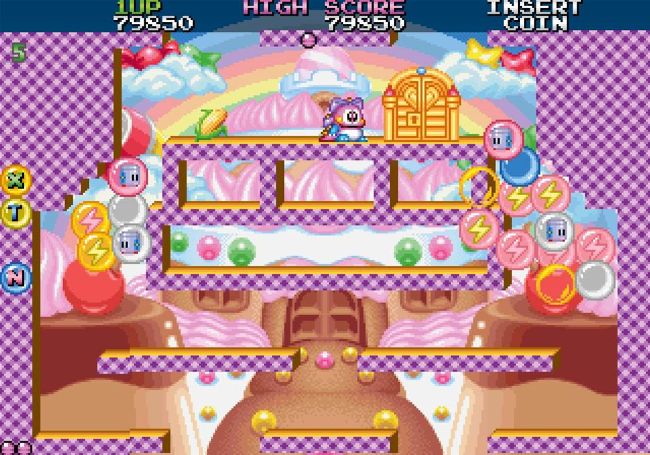
» [Arcade] Some doors bring visitors from other worlds, but others lead to strange places…
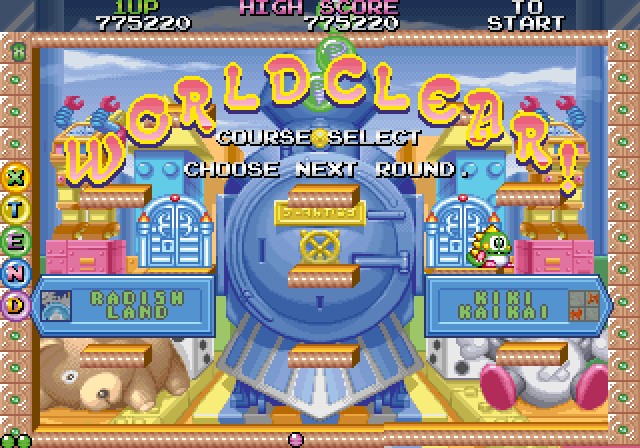
» [Arcade] Your journey will take you across many branching paths – including into the worlds of other Taito games!
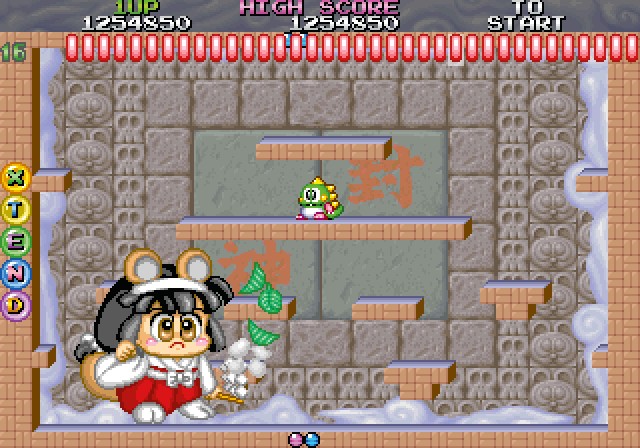
» [Arcade] Sayo from Pocky & Rocky turned big and evil. Wait, is that really Sayo?
The origins of Bubble Symphony can be traced back to 1992 when Taito introduced the F3 board – its new state-of-the-art 2D arcade hardware.
In 1994, Taito developed the F3 Package System – modular hardware meant to compete with SNK’s popular Neo Geo. Taito pushed this new system hard, debuting it with its fighting game Kaiser Knuckle, but it knew it needed iconic game brands to really sell the new hardware in arcades.
Taito soon announced new games in two long-dormant series: Darius Gaiden and Bubble Symphony. A shooter and a single-screen platformer may have seemed doomed in the fighting game-saturated market of 1994. Yet in a twist of fate, Kaiser Knuckle would become notorious for all the wrong reasons, while Darius Gaiden and Bubble Symphony would go on to be remembered as classics, standing out precisely because they weren’t chasing the trends.
Taito had likely entertained the idea of a proper sequel to the arcade Bubble Bobble for a while. While Rainbow Islands may have been ‘The Story of Bubble Bobble II’ gameplay-wise, it had little in common with it. Certain PC/ console ports of Bubble Bobble expanded on the base game, changing things up with new secrets, items and levels. And due to the enduring popularity of these ports, in 1993, Bubble Bobble Part II released for the NES and Game Boy – though it wasn’t made by an internal Taito team.
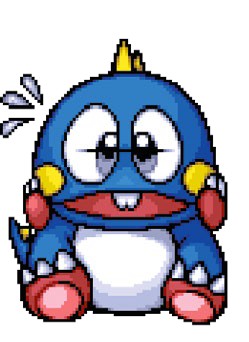
But while somebody else was making the NES Bubble Bobble Part II, a group of developers centred around Taito’s Osaka development branch were working on a project for the F3. Tentatively titled Bubble Bobble II, it went out for covert location testing in arcades in late-1993 to see if arcade players would still get excited over the prospect of a new Bubble Bobble. The response must have been encouraging in some way, because several months later in 1994, Bubble Symphony would make its arcade debut.
Taito’s sequel picks up years after the events of Bubble Bobble and Rainbow Islands. The children of Bub, Bob and their girlfriends are roughly the same age as their parents were when they had to venture into the Cave Of Monsters. But the son of Super Drunk, Bubble Bobble’s final boss, has also come of age, and he’s still mad about how Bub and Bob beat his dad. While Bub and