THE MAKING OF Cadaver
PUTTING FRENETIC-PACED ARCADE GAMES TO ONE SIDE FOR A MOMENT, THE BITMAP BROTHERS MADE ITS WAY INTO THE WORLD OF ISOMETRIC 3D ADVENTURES AND FOUND AN AUDIENCE EAGER FOR MORE. MIKE MONTGOMERY, DAN MALONE AND GRAEME BOXALL RECALL THE EXPERIENCE
WORDS BY DAVID CROOKES
IN THE KNOW
» PUBLISHER: IMAGE WORKS
» DEVELOPER: THE BITMAP BROTHERS
» PLATFORM: ATARI ST, AMIGA, MS DOS
» RELEASED: 1990
» GENRE: ACTION ADVENTURE
Cadaver
was a challenge.
It was difficult, it took a long time to complete and it felt like plunging into the unknown at times – and that was just for the developers. For when The Bitmap Brothers created this acclaimed action adventure game, the industry’s self-professed “rock stars” was effectively finding its feet in a genre it had never attempted to craft before. The fact it pulled it off to the same high standard as its other titles was testament to the abundance of talent and skill which ran throughout the company’s small team.
“We just wanted to make the game,” says Mike Montgomery, one of the developer’s three cofounders. “We’d worked on two arcade-type titles, the scrolling shooter Xenon and the futuristic sports game Speedball, but we didn’t want to be pigeon-holed. We wanted to try something new and we’d been looking at isometric games on the Spectrum such as Knight Lore. But, yes, it posed problems because we’d never really done anything like it. It really was a challenge.”
Steve Kelly, another of the cofounders, was the game’s primary driving force. It was his desire to develop an adventure game which saw him create a simple 3D map maker on the Atari ST which, he later told Amiga Power magazine, was “not unlike the old 8-bit ones”. Called the Adventure Level Editor, the tool made it incredibly easy for a designer to put together isometric 3D levels without the need for any programming experience.
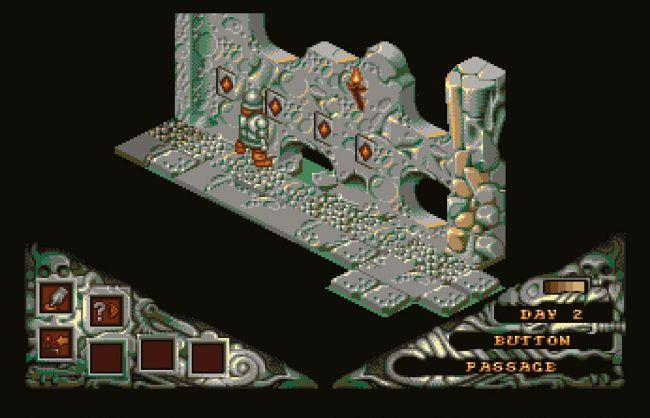
» [Amiga] For this puzzle, you need to push the buttons on the wall in a particular sequence.

» [Amiga] Lobbing a pickaxe from afar at this particular wall is enough to see it crumble.
Initially, a level would be created in 2D by defining the size of a room – anything from 3x3 to 10x10 floor tiles – and a map would be created, showing any pathways from one room to another.
A designer would then be able to select a room which would display as a 3D shell with a defined height up to eight units that could be filled with graphic blocks. Doors would be automatically added depending on the position of the corridors and objects would be placed in each room, effectively taking a Lego-like approach to the visual construction of each defined space.
Steve, who had previously worked at Psion Software before going freelance, told Amiga Power that the editor was started “almost for fun” and “simply grew out of proportion”. Indeed, the Adventure Level Editor spawned the development of the Adventure Creator Language. It gave objects a unique number and instructed how they could be used depending on the current state of the game. For instance, it would determine if a lever was on or off, if an object could be touched, moved or taken and what could happen if the player had been able to interact with an item. Entirely flexible, it could make light work of otherwise complex processes.