DIETER VOKINGER AND HIS SWISS HUTLESS
The German Taifun kart was very successful at the end of the sixties and at the beginning of the seventies, so much so, that many kart manufacturers at that time were influenced by the shape of the Fritz Schöfer design hoping that their chassis, if made to resemble the Taifun, would perform in a similar manner to the successful kart constructed by Fritz and his two sons in Feldmoching near Munich.
ARTICLE: FRANK WEIR AND KEES VAN DE GRINT
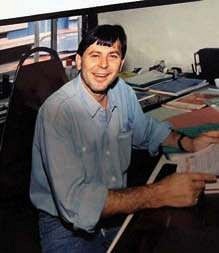
1. Dieter Vokinger 1948 – 2001.
Photo: Jurg Vokinger
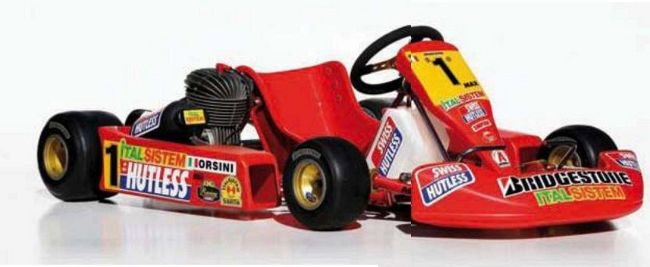
2. Glen Davidson’s replica of Max Orsini’s 1995 World Championship winning Swiss Hutless/Italsistem.
Photo: Glen Davidson
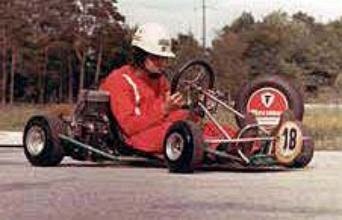
4. Dieter driving one of his first Swiss Hutless karts circa 1971.
Photo: Archive KVDG
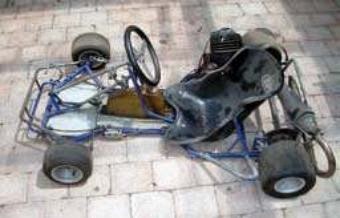
5. Hutless/Komet circa 1971 from which the Swiss Hutless was developed using the original German fixtures and tooling.
Photo: Gernot Stöcker
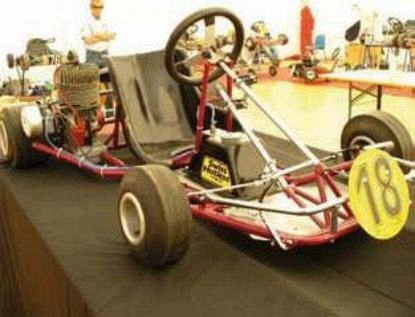
3. The Swiss Hutless/BM circa 1971 with another karting legend the late Martin Hines in the background.
Photo: Timeline
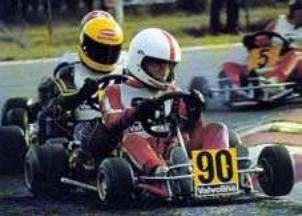
6. Peter de Bruijn on his way to winning the 1980 World Karting Champion for Swiss Hutless closely followed by runner-up Ayrton Senna.
Photo: Archive KVDG.
Helmut Brandhofer was one person to follow this trend and began fabricating what was basically a Taifun replica which was marketed as a Hutless. Success followed immediately for the Hutless in the hands of Daniel Corbaz who won the 1969 Swiss karting championship. Brandhofer, who would go on to be a top German driver, also used the Hutless at that time to win many national races. Nevertheless in 1971 Helmut Brandhofer switched his allegiance to Taifun and sold the Hutless jigs, tooling and ixtures.
SWISS HUTLESS FORMULA C
Glenn, a great enthusiast of restoring karts and well-known for producing loyal replicas of the karts that have made the history of our sport, has recently been working on a Swiss Hutless. More specifically, this is the vehicle with which Giuseppe Palmieri and Massimiliano Orsini ran (he chose the latter’s race number) in the 1997 European Championship races, wherein excellent results were achieved. The kart was in very bad condition, with plenty of rust and parts that were not original. The engine was a TM K8. The first job was to find the original plastics of the era produced by KG in red. The stickers were then recreated as per the original graphics of the time. Then a thorough restoration was carried out, seeking as much as possible to find original spare parts from warehouses. The end result is definitely fantastic!