Mobile HOMES
A coop on wheels keeps your fields and flock in good relations while keeping you in pasture-raised eggs.
By Matt Fowler
If you’ve eaten an egg from a pasture-raised chicken, you realize what makes pastured eggs so special. Pastured eggs have nutrientrich yolks that can border on a dark-orange color. The yolks tend to be stable and stand up when placed on a flat surface. Yolks can be separated from the egg white without fear of breaking. In fact, a good test of a pasture-raised egg is to see whether you can separate the yolk from the white with your fingers without breaking the yolk.
Each pasture-raised egg has a strong vitelline membrane around the yolk that protects it and gives it a much more rounded surface than that of a store-bought egg. The middle albumen is made of a thick white layer, which is dense in pasture-raised eggs but much more fluid in store-bought eggs. It’s noticeable how much higher the albumen stands and how much less it spreads in a pasture-raised egg. A pasture-raised egg is a recognized superfood that is unlike any caged-chicken egg you can buy in a grocery store.
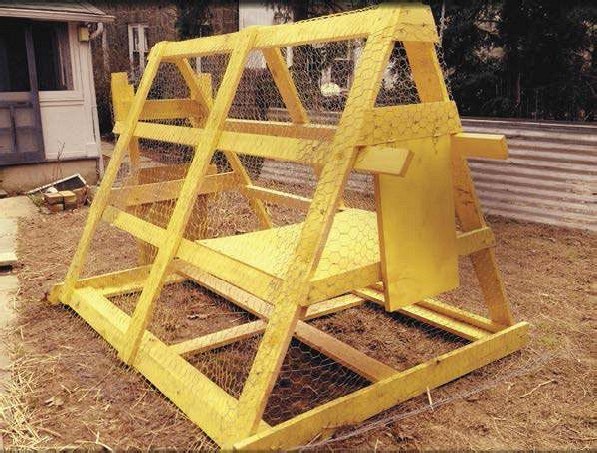
Chicken tractors don’t have to be elaborate to be funcational, especially for a small-pasture setting.
STEVENJOHNSON/FLICKR
So, how do you get your chickens on pasture? After all, a flock of chickens can turn any lush green space into a compacted, barren space resembling the surface of the moon in a matter of days. In order to avoid this moonscape and keep your egg-layers on lush green pasture, you need to regularly rotate your coop as well as your chickens.