New to cross stitch? Our handy guide will take you through all the basic techniques and stitches you need to get you started
THEESSENTIALKITYOU’LLNEEDTOSTARSTSTITCHING
FABRICS
Aida is the ideal choice for cross stitch beginners – it is a block-weave fabric, which is divided into squares with a grid of holes. Each cross stitch is worked over one square. Aida comes in a range of sizes which are called counts. So 14 count means that there are 14 squares to the inch and this will make 14 cross stitches. Aida also comes in 16, 18 and 20 count. The larger the number, the more stitches to the inch and so the smaller the design will stitch up.
Evenweave is a woven grid of threads in a finer count. Each stitch is usually worked over two threads, so a 28 count evenweave with each stitch worked over two threads will mean your stitching will be the same size as if you stitched on 14 count aida. Fractional stitches are easier to work on evenweave, as there is a central hole so there is no need to split the block as with aida.
Once you are confident try using linen, which is produced in some even finer counts like 32, 36, 40 and even 56 count.
NEEDLES
For cross stitch you will need a tapestry needle that has a blunt tip and a large eye. Use size 24 for 14 count or 28 count evenweave, and a 26 for 16 count aida or 32 count evenweave. Use a sharp embroidery needle for finer details such as backstitching and French knots. A thin beading needle is also very useful.
STRANDEDCOTTON
Embroidery thread is also called stranded cotton, or floss in the USA. Each thread length is made up of six strands of cotton twisted together. The chart key tells you how many strands you’ll need to stitch with. Stranded cotton comes in skeins of 8m, and in three main brands – DMC, Anchor and Madeira – all are divisible and colourfast to 95 degrees.
EMBROIDERYSCISSORS
Embroidery scissors with small sharp points are important for cutting stranded cotton and unpicking. Use these scissors just for cross stitch, and do not use them to cut fabric. A separate, larger pair should be used to cut aida and evenweave. Protect the tips from getting damaged between uses, and do not use for paper.
HOOPSANDFRAMES
Though not absolutely essential, we do recommend using an embroidery hoop or frame to keep an even stitching tension when you are working on a large project that is heavily stitched. For cards or small projects it may be easier to hand hold the fabric.
Start stitching…
on aida
Step 1
CUT a 40cm thread length, and thread your needle with two of the six strands. Knot one end and start with a waste knot (below). Make a diagonal half cross stitch across a single aida block.
Step 2
MAKE a second diagonal stitch to make the cross. You can work a row of half cross stitches first, then work back on yourself to complete the stitches. All the top stitches should face the same way.
and…
on evenweave
INSTEAD of taking your needle diagonally across a single aida block, take your needle diagonally across two evenweave threads, creating a half cross stitch as before.
STARTING A THREAD
1. Away waste knot
KNOT one end of your thread and take it down through the front of your fabric, 2cm from your starting point.Bring it back up to the front of the fabric to make your first stitch. Begin stitching your design, making sure you stitch over your starting thread with each stitch. Once you’re happy that your starting thread is secure, snip off the knot. To secure your thread when you’ve finished stitching, weave it through the back of your stitches.
2. Loop knot
WORKING in two strands makes a loop knot the neatest method. Cut a single length of thread, twice as long as normal. Fold in half to create a loop at one end. Thread your needle with the two tail ends. Bring your needle up to the front of your fabric, leaving a small loop of thread on the reverse. Make a half cross stitch, passing your needle through the loop on the reverse, as shown. Pull all the way to secure the thread then continue with your stitching.
Front of fabric Reverse of fabric
ADDING BACKSTITCH OUTLINES & DETAILS
Step 1
WORK your backstitch once you’ve finished the cross stitch. To secure your thread, weave it through the back of your stitches, then bring your needle up to the surface.
Step 2
MAKE each backstitch over one thread of fabric on aida and two threads if you work on evenweave. Follow the chart to see where to place each one.
FRENCH KNOTS
Step 1
BRING your needle up at your starting point and wrap your thread once or twice around the needle. Use one strand for a small knot and two for a chunkier knot. Hold your thread end firmly and take your needle down, ever so slightly away from where you came up. Slide the twisted thread down the needle, so it rests on the fabric’s surface.
Step 2
FEED the needle gently through the fabric. Try to keep your thread as taut as possible to prevent the knot becoming loose. Gently pull your thread through to tighten the knot, so that it sits neatly on the surface. Keep practising your French knots until you are happy you have perfected the technique.
FRACTIONALS
These stitches are great for adding a bit more detail to your work
START with a quarter stitch, working from one corner into the centre (with aida, you’ll need to pierce the fabric). Make a quarter stitch in your second colour, coming up from the opposite corner and back down the centre. Finish with a half cross stitch. Fractionals are charted either as two symbols opposite one another in a square, or as a symbol opposite an empty space.
BEADING
TO attach beads, you’ll need a thin, flexible beading needle. Thread with one strand of cotton. Bring your needle to the front of your design, thread on a bead and make a diagonal stitch to secure the bead. If you like, stitch through again for added security.
WASTE AND SOLUBLE CANVAS
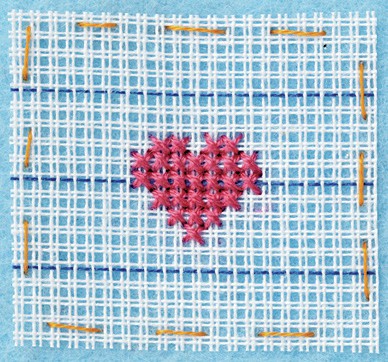
WASTE CANVAS
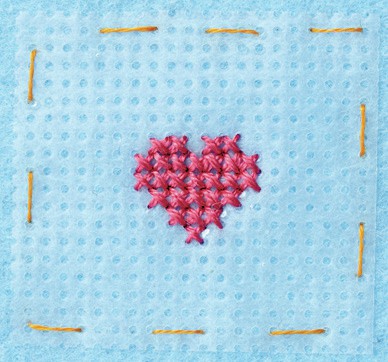
SOLUBLE CANVAS
WASTE and soluble canvases are used when stitching on plain fabrics and felts. Tack onto your fabric and stitch as normal. Soluble canvas dissolves in water. For waste canvas, soak in water then remove each thread individually.