Amazing images
LAUNCHPAD
© ESA
29 May 2024
Webb finds a dusty skeleton in a starburst galaxy’s closet
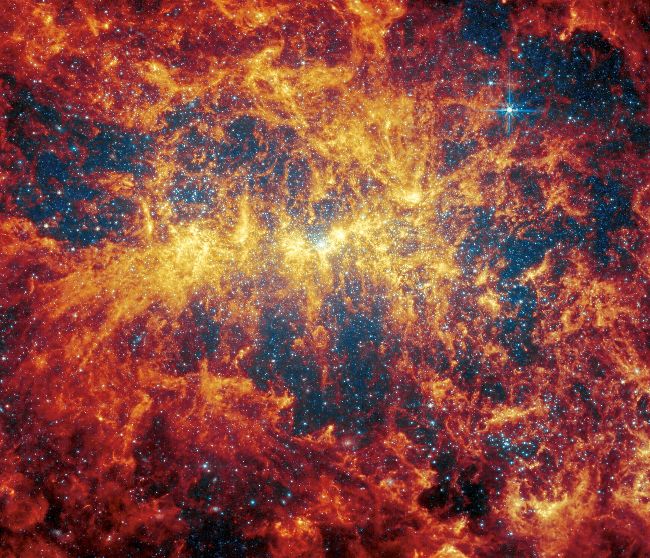
The dwarf galaxy NGC 4449 is the star of the show in the James Webb Space Telescope’s latest cosmic portrait. Located 12.5 million light years away in the constellation of Canes Venatici, the Hunting Dogs, NGC 4449 has much in common with our very own Large Magellanic Cloud (LMC), the satellite galaxy orbiting the Milky Way. Both are small and irregular in shape, and each has a distinctive bar running through its centre. However, whereas the LMC has one extreme region of star formation, which is the 30 Doradus region famously known as the Tarantula Nebula, NGC 4449 has enhanced star-forming rates across its length and breadth. Indeed, there’s so much star formation going on that NGC 4449 is described as undergoing starburst.
NGC 4449 is part of the M94 Group of about two dozen galaxies, so it has several neighbours with which to interact. Indeed, in 2012, a professional-amateur collaboration led by David Martinez-Delgado of the Max Planck Institute of Astronomy in Germany and featuring the work of several notable amateur astrophotographers, as well as observations by the Subaru Telescope on Mauna Kea in Hawaii, found evidence for just such an interaction. The team resolved a stream of stars pulled out of a smaller galaxy that had met its demise by being consumed by NGC 4449.