Getting loft conversions right
Need more space, but can’t face the upheaval and cost of moving? Improving what you’ve got by transforming the attic could be the way forward, says Chris Bates
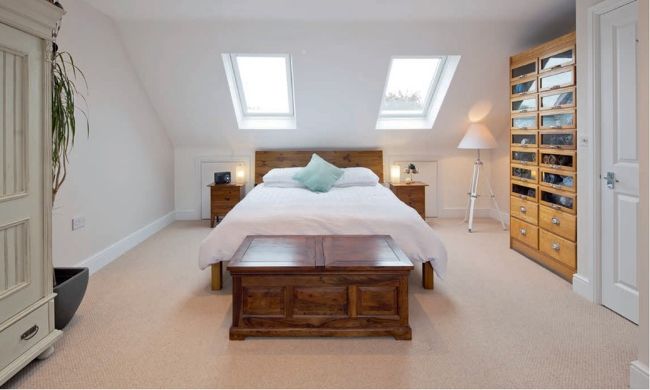
This scheme by Landmark Lofts shows how rooflights can provide a huge amount of natural brightness – making them an ideal daylighting solution if there’s no need to add extra height
Converting your roof space can be one of the simplest and most cost-effective ways of adding space and value to your home – all without having to gobble up any garden amenity. It offers great flexibility, too. “The new zone could be used for an array of purposes,” says James Gold, managing director at Landmark Lofts. “It might be a master suite with a walk-in wardrobe, teenager’s bedroom, writing room or even a space to rent out to lodgers.” Other common uses include music rooms, games areas and cinema suites.
Exactly what uplift in value you get will depend on your property’s location, but generally the gains are biggest in urban areas. “A well-designed scheme can give more valuefor-money per m2 than any other type of extension,” says Becke Livesey, director at Econoloft. What’s more, in many cases the work can be done in as little as six to eight weeks.
Small wonder, then, that transforming an attic space is such a popular investment – but it’s still a major building operation, and there’s plenty to think about before you embark on a project. Here’s our guide to getting it right:
Do I need planning consent?
Many loft conversions fall under permitted development (PD) rights. This means you can cut out a lot of red tape, as you won’t normally need to apply for planning permission for a straightforward project, even if it involves a modest increase to the size of the roof space. The key constraints to bear in mind are as follows:
• Any additional volume created must not exceed 50m 3 (or 40m3 for a terraced house). So extra space added by dormers, hip-to-gable alterations etc cannot exceed this size if the project is to fall under PD rights.
• Previous roof extensions count towards the total additional volume allowed, even if they were undertaken by a previous owner.
• At the principal elevation (facing the highway) no extension is permitted beyond the plane of the existing roof slope – so you won’t be able to add dormers or similar structures at the front of the house.
• Even at the rear and sides, you can’t extend above the highest part of the roof.
• You should use materials that are similar in appearance to the existing house.
• Side-facing windows have to be obscure glazed to maintain privacy, and must be fixed (unless the opening part is at least 1.7m above the floor).
• Dormers and most other extensions need to be set back at least 200mm from the existing eaves, unless achieving this is impractical.