Camera College
The complete guide to modern photography
Marcus Hawkins
Photographer and writer Marcus is a former editor of Digital Camera
Use your camera’s continuous drive setting so that you give yourself more options in the edit .
Photo challenge!
You could win a copy of Affinity Photo See page 79
Coastline composition
How to work out where to place the horizon to suit the scene and your narrative
When you’re taking your first steps in landscape photography, the rule of thirds is a reliable way of creating well balanced compositions. It’s a tried-and-tested technique, where you imagine a noughtsand-crosses grid over the scene in front of you, then line up the horizon with either the bottom line or the top line in the grid.
In fact, you don’t even need to imagine it, as today’s cameras can display a grid over the Live View image, either on the rear screen of a DSLR or in the electronic viewfinder of a mirrorless camera.
There are essentially three elements to balance when you’re shooting a seaside scenic: the sea, the sky, and the shoreline.
Which of these you give most prominence to depends on where the interest lies. If the sky has some interesting clouds, consider giving that two thirds of the space. Do the opposite if the shoreline or the sea is where the action is.
It also depends on what you want your picture to say. If you want to exaggerate the wide open feel of a location, allowing a bit more space for the sky can do this effectively.
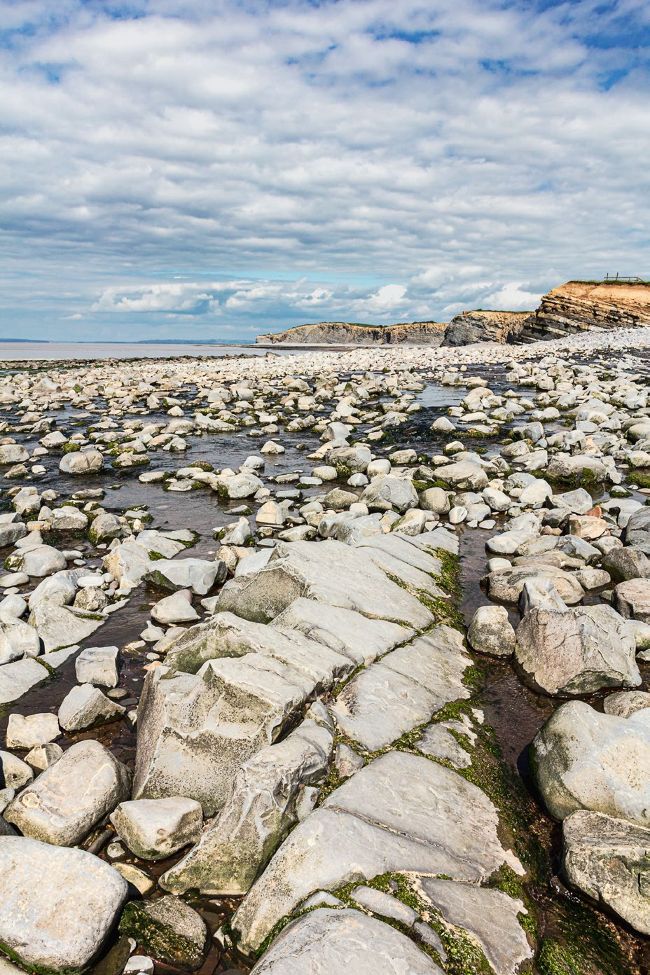
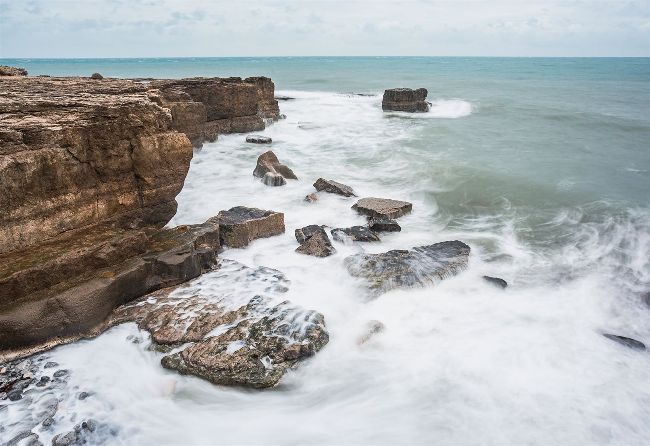
Are you shore? Use the rule of thirds (left) as a rough guide to where to place the horizon. Don’t feel that you have to follow this ‘rule’ religiously, though – any off-centre position can work equally well.
Pack a polariser
■ A circular polariser is a brilliant filter for beach photography, as it can cut through reflections on the surface of the sea. This gives colour saturation a boost, which can be beneficial when you’re shooting in a part of the world that has an aqua‐coloured ocean.
To achieve the maximum benefit, you need to be shooting at 90 degrees to the sun; hold your thumb and index finger in a gun shape, aim your thumb at the sun, and shoot in the direction your index finger is pointing.
A circular polariser is a two-part filter: rotate the front part while you look through the viewfinder to see the effect get stronger and weaker. Make sure you rotate it in the direction that you use to tighten the filter, so that you’re not inadvertently unscrewing it.
Polarisers can give an uneven effect with ultra-wide lenses, although this is often more noticeable in blue skies.
Unpolarised
Polarised