TOXIC MUSHROOMS
Why some fungi are so poisonous and how to spot them
WORDS SCOTT DUTFIELD
Earth’s forests are littered with the weird and wonderful umbrellas of mushrooms – some edible and some deadly. Mushrooms are classified as the reproductive structures of some, but not all, species of fungi. Similarly to how fruits bear the seeds of some plants, mushrooms are filled with millions of spores, held in their gills. These spores ride the wind or hijack a lift on a passing animal and travel to their new home to begin another mushroom population.
There are around 14,000 different mushroom species within the 3.8 million species of fungi on Earth. Of those thousands, around one per cent are
poisonous and a handful of them are deadly enough to kill a human. Through ingestion, and in rare cases through touch, mushrooms can deliver a collection of toxins that wreak havoc on the human body. This can include inte rnal organs failing, gastrointestinal issues and can even cause parts of the brain to shrink.
Did you know?
Squirrels and rabbits can eat death caps unharmed
The most popular theory behind why some mushrooms have evolved to be so poisonous is for protection from being eaten by certain species, including humans.
One of the leading causes of mushroom poisoning is a lack of knowledge in identifying fungi and misidentifying harmful mushrooms for edible alternatives. Here are a few of the worst offenders.
DID YOU KNOW? Studies have found that there are thousands of different fungi species in a single soil sample
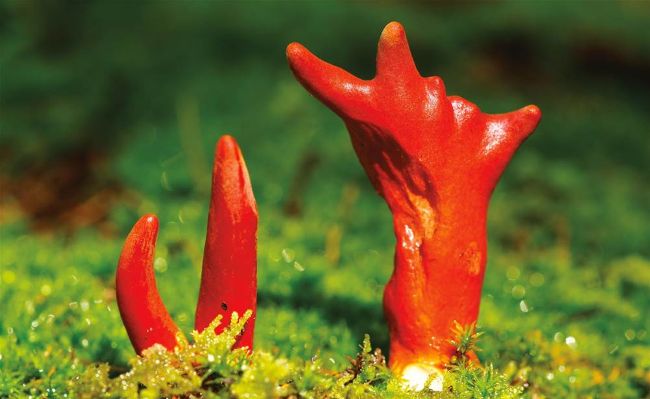
A poison fire coral emerging through a mossy forest floor
POISON FIRE CORAL
PODOSTROMA CORNU-DAMAE