EMULATION
Explore Forth on the Jupiter Ace
Mike Bedford reveals the Jupiter Ace, the contemporary of the Sinclair ZX81 that was programmed in Forth rather than the more popular BASIC.
Credit: http://lawrencewoodman.github.io/xAce

OUR EXPERT
Mike Bedford has dabbled with lots of old languages at one time or another, but he found this foray into Forth quite an eye-opener.
W hile you’ll recognise names like the Sinclair ZX Spectrum, the BBC Micro and Commodore VIC-20, our subject here is a home computer that far fewer people will remember. It cost £89.95, it looked like a white version of the ZX81, and it wasn’t too different on the inside either – 3.25MHz eight-bit ZX80 processor, 8KB ROM, 1KB user RAM, low-resolution monochrome display and all. Its sales were modest and one reason is that its developers at Jupiter Cantab dared to go against the tide by basing the Ace around the Forth programming language instead of the then almost universal BASIC.
BASIC was designed as a language for beginners, but Forth wasn’t. In fact, Forth is different from the vast majority of languages in some key areas. Those differences offered huge speed advantages on the somewhat limited hardware of the early 80s. In fact an early advertisement referred to the Jupiter Ace as “probably the fastest microcomputer in the universe”.
Somewhat less fancifully, third-party reports estimated its interpreted Forth was between two and 10 times faster than the interpreted BASIC on most home computers, and as fast as compiled software on more expensive microcomputers.
In employing Forth to achieve a major performance boost, albeit at the cost of the language being less intuitive than BASIC, we can be pretty sure that the Jupiter Ace would have appealed to the more technically competent computer user. What better reason could there by for featuring it here in Linux Format?
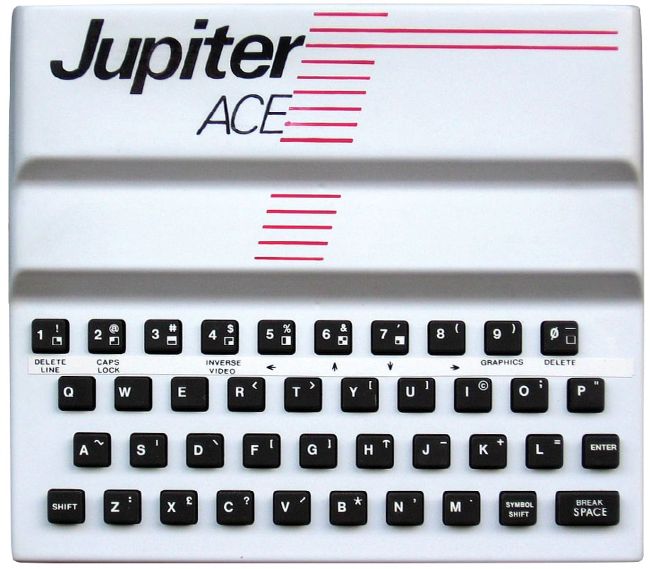
Despite the external similarity of the Jupiter Ace to the betterknown Sinclair ZX81, its use of Forth instead of BASIC made it very different to use.

If you can’t imagine gaming on a black and white low-resolution screen, why don’t you try Acevaders on the xAce emulator?
Jupiter Ace emulators
If you want to get up to speed with Forth you’re going to need a native Linux implementation so you’re not restricted by the Ace’s 24-line, 32-character monochrome display, and we take a look at a Linux Forth later. However, if you want the genuine Jupiter Ace experience, unless you fancy getting your hands on a real Ace – and they command quite a hefty price on the second-hand market – you’re going to need an emulator. We identified two, both open source.
First up is Zesarux, which emulates several of the Z80-based machines of the 80s including the Jupiter Ace. We struggled to install it using the script at https:// github.com/VR51/ZEsarUX-Installer, although downloading the executable from https://github.com/chernandezba/zesarux was trouble-free.