Privacy distributions
Only Batman can give you “clean slate” software, but if it’s anonymity you’re after, Shashank Sharma knows of some distributions that can help.
Shashank Sharma is a legal Deli-based master at keeping his privates covered!
HOW WE TESTED…
Specialist distributions such as the ones featured in this Roundup can’t be tested with the same metric that we would use for desktop distributions. While ease of use is still important, we’re far more interested in what each has to offer, and whether the distros will help you browse the internet, exchange emails, and otherwise interact online without fear of compromising your identity. To that end, we’ll test the five distributions on the protection mechanism they use to mask your online footprint.
A key use for such distros is when working with unfamiliar environments, such as hotels and cafés, so deployment is also important. These distros all use a variety of tools and technologies to keep you anonymous, so proper documentation is also expected from each. Just as important is whether they can keep your data safe and if can they be used as a desktop distribution, too.
One unexpected outcome of the Covid-19 outbreak is that it’s managed to convince even the most technologically averse people to connect online for a variety of tasks. Everything from initiating funds transfer and filing of taxes, can be done online.
Regardless of your fluency with the internet, it’s only natural to wonder if your online activities are safe from prying eyes. The distributions featured in this Roundup enable you to defend your privacy and prevent any inadvertent leaks of sensitive data.
The distros take different approaches and come with their own traits and benefits. Some rely on routing your web traffic via well-known anonymising networks such as Tor, while others use novel approaches such as security by compartmentalisation. Because anonymity and security tend to go hand in hand, using these distros will help you protect your computer from digital assailants.
As with many other open source projects, niche distributions aren’t beyond dying or unexpectedly becoming dormant. For this Roundup we’ve narrowed down distributions that are still in active development, while some alternatives, although not officially dead, are mentioned in the Also_Consider section at the end of the article.
Protection mechanism
What do they use?
There’s no getting around the thoroughness of Kodachi, but that shouldn’t discourage you from using Whonix, Septor or Tails, which have their own USPs.
There are any number of tricks utilised by websites to track your online footprints. Everything from what websites you access to the online purchases you make are all tracked and monitored, so as to enable certain websites and portals to provide an online experience that’s tailored to your exact tastes. You can shield yourself from some of these nefarious activities by purging the browser cookies and taking various other precautions. The more advanced of which is to use the Tor Browser and operate from behind a VPN.
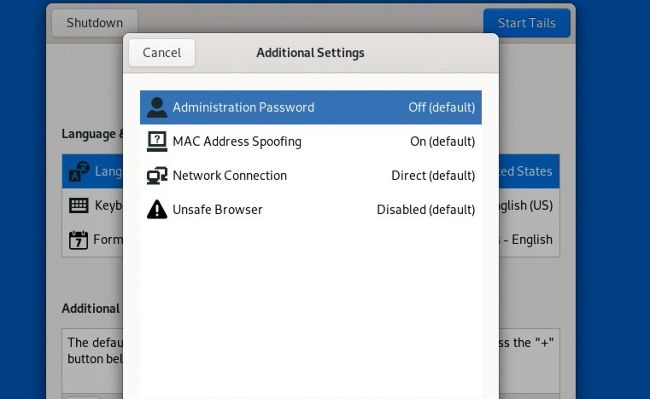
Tails is built around Tor, which is an open network of anonymous servers that attempts to prevent your identification. The distro also includes tools that help set up the network and a web browser with privacy-enhancing extensions. Additionally, Tails includes a couple of useful cryptographic tools to encrypt disks and online communication.
Whonix is built on the concept of security by isolation. The distribution comes in the form of two virtual machines. The idea behind this approach is to isolate the environment you work in from the internet access point. On top of this, Whonix routes all internet traffic through Tor. Thanks to this setup, even if one of the machines is compromised, it would be impossible to uncover your real IP.