WIREGUARD
Host your own secure VPS-based WireGuard
David Rutland takes the LXF VPS server for a final spin. This month, he’s protecting his privacy and watching Mexican TV with a self-hosted VPN.

OUR EXPERT
David Rutland is a man of mystery, and all of his online activities are shrouded under a layer of VPN enabled privacy. Is David Rutland even his real name? No-one knows... and he’s not saying.
Virtual Private Networks are everywhere these days. Search any query of a vaguely technical nature, and most of the time, you’ll end up on a cunningly disguised VPN affiliate site where you’ll find that the answer to your problem is to use a VPN. This is largely due to exhaustive keyword research by VPN companies and pseudo-tech websites that take a substantial commission for every VPN sold.
If there’s an internet-connected device within range, try this query: “How to File Taxes Online Securely in 2022”. The top result on Google, Bing and DuckDuckGo is for a VPN company. With a UK IP address, it’s above the gov.ukresult and above results for genuinely useful tax software. This is clearly nonsense: VPNs, if anything, will bork the process entirely. This is because any public-facing organisation of decent size knows about VPNs, and may or may not choose to take proactive measures to prevent their effective use on that organisation’s sites and services.
This author has written about them before in LXF279, and Jonni Bidwell did a more extensive feature on several providers in LXF286.
The problem
It’s a sad fact that no commercial VPN company will tell you the true use to which punters put its VPNs, and its affiliates won’t either – nor will we. The reason for this is simple: copyright bodies will sue the pants, shirt and shoes off anybody who they deem to be encouraging software, film or music piracy. No one wants to be named as a co-defendant in a lawsuit for contributing to IP theft, so we’ll leave that part to your imagination.
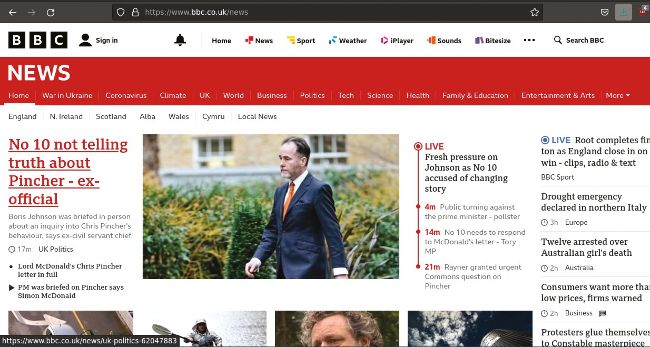
Running your own VPN on your own VPS means you can view UK versions of websites while in the UK – adifficult task with commercial VPNs.
Instead, the advertised features are for “protecting your privacy”, or for accessing geoblocked content, which is still legally iffy, but it’s unlikely that any Mousepaid lawyer is going to get too sniffy about it. The problem is that it doesn’t actually work.
This writer occasionally uses a VPN for purposes that are far too obscure to mention here, and as he does so, he likes to pop along to see what’s happening on the BBC News homepage. Again, this is something that you can try at home.
Commercial VPN companies provide IP addresses for virtually anywhere in the world. You can physically be in Woking, while your IP address indicates that you’re on a large-ish island off the Texas mainland. You can be sunning yourself on the Amalfi coast with an IP address that will swear blind that you’re in a Scunthorpe basement flat.