Supertramp Breakfast In America
New wave and disco reigned supreme, but somehow the sixth album from British prog pop group Supertramp caught the public imagination and mastered the globe. In an article that originally appeared in Prog issue 12, we look back on a band who were falling apart…
Words: Paul Lester

With anywhere between 18 and 20 million copies sold worldwide, Breakfast In America is arguably the biggest-selling prog album of all time after The Dark Side Of The Moon. Not that it was all-out prog - the sleeve featured a waitress pretending to be the Statue Of Liberty against a backdrop of crockery pretending to be the New York skyline; it was released well after prog’s original golden age; and it wasn’t what might be regarded as a quintessentially prog package: it only comprised a single disc and contained 10 tracks - lengthy tripartite song suites were notable by their absence. The total running time was a meagre 46 minutes, two of the songs coming in at under three minutes long, the rest being around the three, four and five-minute mark, with only one clocking in at over seven minutes. Four of the tracks were lifted for single release, which wasn’t something you could say about, for example, Brain Salad Surgery, while the remaining numbers became daytime radio staples throughout 1979 and beyond, in Britain, across Europe, America and Canada, Australia, Scandinavia - most of the known world. In fact, it is rumoured that by the end of that year even those in the furthest-flung corner of the end of the world were able to hum the refrain to The Logical Song and knew every word to the title track.
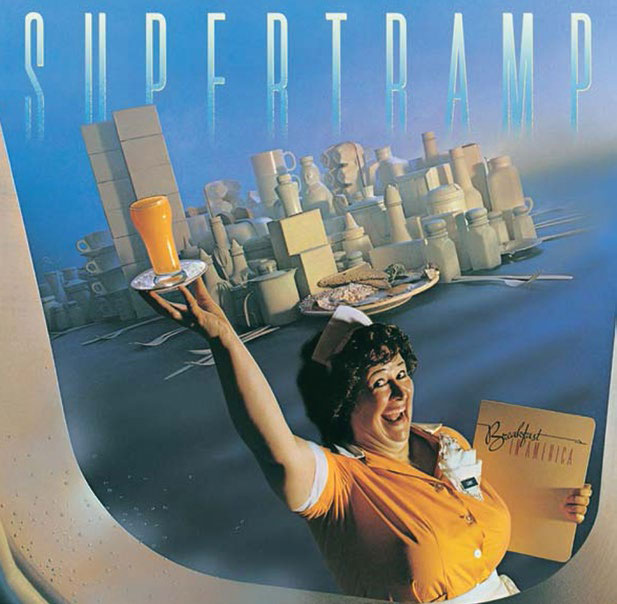
Breakfast In America.
CAMERA PRESS
“We were more likely to go out for an Italian meal than have groupies draped over us or drugged parties in hotels.”
John Helliwell
That the album did so well was particularly impressive considering that it was Supertramp’s sixth long player, and its release came at the height of new wave and disco. Its domination of the single and album charts, and the airwaves, was quite unexpected by all concerned - by all, that is, except the band’s label boss, Jerry Moss.
“Jerry came down to the studio and said something about Peter Frampton - who was also on A&M - and us being likely to repeat his success,” recalls Peter Henderson, credited as co-producer alongside the band. “Basically, he said, ‘I think you guys are going to be next.’”