Recommends
Art Emma Crichton-Miller
Actions. The Image of the World Can Be Different
Kettle’s Yard, Cambridge, 10th February to 6th May
In 1944 the sculptor Naum Gabo argued that abstract art’s role was to assert that “the image of the world can be different.”Gabo was a friend of Jim Ede, the passionate collector who founded the gallery Kettle’s Yard believing in art’s power to transform minds. Reopening after an ambitious two-year building programme, Kettle’s Yard is again affirming this ideal. The exhibition combines key works by Henri Gaudier- Brzeska (below) and Barbara Hepworth with works from modern artists. New commissions will be dotted around Cambridge
All Too Human: Bacon, Freud and a Century of Painting Life
Tate Britain, 28th February to 27th August
“I want paint to work as flesh,”said Lucian Freud. Tate Britain presents those British artists—from Walter Sickert to Paula Rego, with Freud and Francis Bacon at their core—obsessed with finding new ways to depict the human figure, inspired as much by human frailty as by grandeur. The show brings together works by Stanley Spencer, Frank Auerbach, RB Kitaj, Jenny Saville and Lynette Yiadom-Boakye.
Journeys with The Waste Land
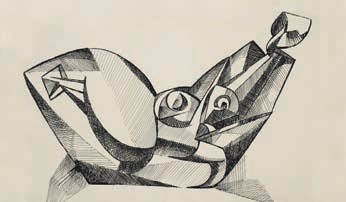
Sketch of Bird Swallowing a Fish (1913- 1914) by Henri Gaudier-Brzeska
Turner Contemporary, Margate, 3rd February to 7th May
TS Eliot wrote part of The Waste Land in 1921, sitting in Margate’s Nayland Rock Shelter: (“On Margate Sands./ I can connect/ Nothing with nothing.”) This exhibition traces the impact of his seminal poem on the visual arts. Artworks range from Edward Hopper’s Night Windows (1928) to John Newling’s sculpture Eliot’s Notebooks (2017), a project to rot hundreds of copies of The Waste Land into soil, and eventually turn them back into paper