FILMS
FILMS
Bovine larceny in 1820s Oregon; Ben Wheatley’s return to folk-horror roots; it’s a pig’s life and more…
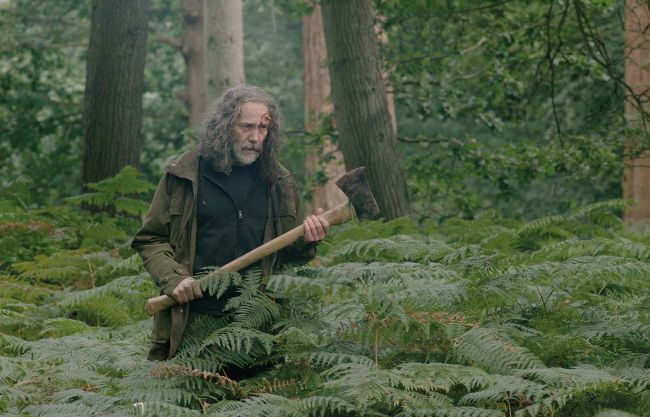
In The Earth: Reece Shearsmith playsa different kind of eco-warrior
FIRST COW By inclination a miniaturist, Kelly Reichardt isn’t necessarily what you’d think of as a great director in auteur upper case. But she’s one of the most individual and incisive voices in contemporary cinema, whose vision becomes richer and more complex film by film. After eco-politics drama Night Moves and character portmanteau Certain Women, Reichardt’s First Cow returns to the unmapped margins of the western, which she previously explored in 2010’s pioneer drama Meek’s Cutoff.
Set in backwoods Oregon in the 1820s, First Cow is a tragi-comedy about friendship and survival. It concerns two men who provide each other with shelter from a brutish world: quiet ‘Cookie’ (John Magaro), who’s having a miserable time providing victuals for a party of trappers, and King Lu (Orion Lee),a Chinese immigrant getting by perilously on his wits. Forming a close bond, they set up shop selling ‘oily cakes’ – fritters with a secret ingredient, milk stolen from the one cow in the vicinity. The tactic proves risky when the English official in charge of the local settlement (Toby Jones, pricelessly self-important) develops a taste for the sweetmeats.
Here the film takes on a brittle comedyof-manners tone, set against the raucous edge of frontier life. Known for depicting women’s experiences, Reichardt here looks at masculinity – but of a more vulnerable kind than you usually associate with the Old West. This focus echoes Old Joy – her breakthrough film, set in the Oregon wilderness – and First Cow recaptures that film’s attention to landscape, with a tactile evocation of leaf, branch, mulch and mud. The lead duo are superbly empathetic and often very funny in their fond, taciturn interplay. First Cow tells a quietly devastating story but, typically for Reichardt, it leaves you with unresolved questions and unresolved feelings to mull over – or should that be ruminate? – long after it ends.
IN THE EARTH Some filmmakers dealt with the challenge of lockdown by staying indoors and taking to Zoom as a creative panacea. Ben Wheatley, instead, took to the trees – and in the process seems to have rediscovered the pleasures of being Ben Wheatley. After his decorous but impersonal remake of Rebecca, In the Earth is a science-fiction-cum-occult-odyssey (if ‘odyssey’ is the word for something so determinedly small-scale) that recaptures some of the DIY creepiness of the UK cult director’s Kill List and English Civil War freakout A Field In England.
Joel Fry plays a scientist on a mission during a pandemic. He and a forest ranger (Ellora Torchia) head out in search of a researcher, Dr Olivia Wendle (Hayley Squires), who has gone missing – and conceivably gone full Colonel Kurtz – somewhere out amid the greenery. But first they must contend with Zach (Reece Shearsmith), an off-the-grid loner with his own radical-eco agenda and an alarming sideline in first aid.
Exotic fungi and outré sound design bring matters to a point of psychic and filmic meltdown that marks this as an experimental art-horror crossover – although genre purists might justifiably feel that this kind of ending isn’t really doing due diligence. The path there is engaging, if you can take the abrupt shifts in tone – from baleful Quatermassian build-up to farcical grand guignol to a strange register of technofied folk horror. Fry holds it together as a dorkishly vulnerable lead while Shearsmith contributes macabre comic zeal, although curiously, Squires chooses to play her posh boffin as if in deep trance. In The Earth is altogether game, if not quite a triumphant return to Wheatley’s roots, but it’s nice seeing him rolling up his sleeves and getting his hands dirty again.
GUNDA More grubbing in the dirt comes in Gunda, by revered Russian documentarist Victor Kossakovsky, following his spectacular eco-study, Aquarela. Gunda is small-scale, simple and wordless, and arguably offers more profound insight into the condition of being alive than any other recent film. And it’s about a pig.
REVIEWED THIS MONTH
FIRST COW
Directed by Kelly Reichardt Starring John Magaro, Orion Lee Opens May 28 Cert To be confirmed 9/10
IN THE EARTH
Directed by Ben Wheatley Starring Joel Fry, Ellora Torchia Opens June 18 Cert To be confirmed 7/10
GUNDA
Directed by Victor Kossakovsky Opens June 4 Cert To be confirmed 9/10
THE KILLING OF TWO LOVERS
Directed by Robert Machoian Starring Clayne Crawford Opens June 4 Cert To be confirmed 7/10
AFTER LOVE
Directed by Aleem Khan Starring Joanna Scanlan, Nathalie Richard Opens June 4 Cert 12A 7/10
Strictly speaking, it also features some cows and a group of inquisitive chickens. But we couldn’t be further from anthropomorphic Disney cuteness. Gunda is, for the most part, a close observation of a sow and her litter, the camera getting deep into the sty as the piglets emerge one by one and venture into the world. It’s a film partly about discovery, about what it would be like to be born and instantly go snuffling your way around a new universe.
Kossakovsky, using discrete and ingenious techniques, takes us deep into a world most of us never consider – and one in which humans are never seen. Nevertheless, the effect that we unthinkingly have on animals and their experience of life is brought home in an extraordinary closing sequence that attains the emotional charge of high tragedy – and no doubt explains why animal rights campaigner Joaquin Phoenix came on board as executive producer. Kossakovsky makes no overt comment in the film but, by the end, Gunda and her squealing progeny have taught us more than you’d imagine possible about the precarious condition of being alive – and, indirectly, about the human condition too.
THE KILLING OF TWO LOVERS In the ’80s, Granta magazine applied the phrase ‘dirty realism’ to a school of American fiction associated with writers like Raymond Carver and Richard Ford. By the end of that decade, the label was best exemplified by the boom in US indie cinema. If you wanted to give an example of ‘dirty realism’ in its rawest cinematic form, you might choose The Killing Of Two Lovers, a drama by Robert Machoian. This no-frills psychological drama is set in a tiny Utah community, where David (Clayne Crawford), an unemployed middle-aged musician, lives apart from his wife Nikki (Sepideh Moafi) and their four children. The couple evidently still love each other but she’s seeing someone else and David is struggling to contain his jealous fury beneath a laidback exterior.
Sci-fi meets the occult in arthorror crossover In The Earth
The film’s title and ominous opening wrongfoot us, for little happens for much of the film. We see David trying to be an affable pop with his three young sons and deal with the resentment of his teenage daughter (a very impressive Avery Pizzuto) – even sing Nikki a creaky work-inprogress love ballad. Then comes an out-ofnowhere ending that knocks you sideways.
It’s a film that seems to downplay style but director Machoian knows when to play his hand – notably in tour de force shots where he keeps the camera fixed in the cabin of David’s truck, as the world careers by head-spinningly outside.
The acting is superb, Crawford exuding a compressed intensity reminiscent of Michael Shannon. This is American minimalism very much in a Carver tradition, or in the ballpark of a Springsteen narrative song. Or rather – it’s that pared down – of just a single verse.
AFTER LOVE By contrast, while British cinema can get gritty too, we also specialise in what you might call ‘discreet realism’ – undemonstrative psychological drama in which emotions are muted than on raw-nerve display. A prime case is After Love, the debut by writer-director Aleem Khan. Joanna Scanlan plays Fatima, née Mary, who converted to Islam when she married a man who works as an officer on a cross-Channel ferry. After his sudden death, she discovers that he had a whole secret existence in Calais, and travels there to confront the other woman in his life.
Starting out by evoking Fatima’s agonised grief, After Love then turns briefly into a downbeat comedy of misunderstanding. Her rival Geneviève (French art-cinema mainstay Nathalie Richard) assumes that Mary has come to clean her house – so the Englishwoman settles in with apron and mop, and eventually makes a connection with Geneviève’s teenage son (Tarid Ariss).
After Love may feel like a simple sliver of a drama –a sketched anecdote, rather than a full-blown feature – but its nuanced emotional acuteness emerges from the interplay of Fatima’s often near-silent reserve and Geneviève’s garrulous nerviness, as well as the enclosed staging (the drama takes place almost entirely indoors). This is a film of delicate but incisive dramatic insight that is also strong on themes of community, identity and belief. Scanlan excels in a performance that is at times dialled down to the lowest volume, yet is quietly mischievous and all the more affecting for its reserve. There are no fireworks here but the volcanic turbulence is there, deep down.
JONATHAN
ROMNEY