TECHNIQUES
Pro guide to FILTERS
The key to great photography isn’t just in the editing process. Using filters can help manage exposure, colour and sharpness for superior images in-camera
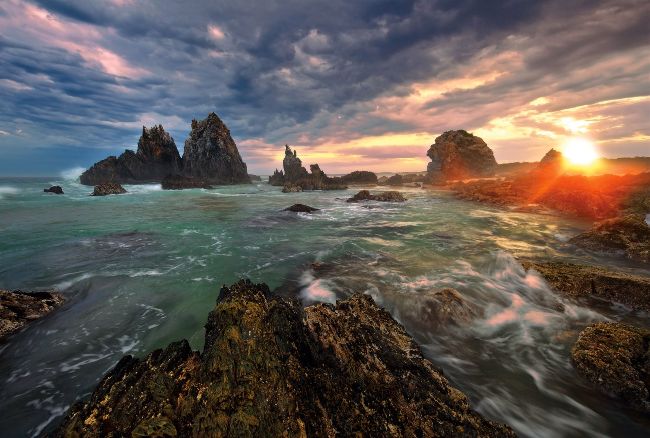
Pictured
Filtered perfection Even with advanced photoediting software available, hardware filters offer unique effects that can produce incredibly dramatic results, while retaining a natural style
© Wayne Bradbury
“Filters give the photographer the unique capability to not only control a scene more effectively, but also to impart their own creativity.”
Simon Garratt, LEE Filters
It’s easy to forget the role that hardware filters have played in the development of photography as we know it today. Before it was possible to easily blend exposures, either in the darkroom or using software at the computer, it was critical to be able to control the amount of light entering the camera, at the moment of image capture.
As soon as cameras are taken out of the studio and into the field, the issue of uneven brightness throughout the landscape starts to take effect. The intensity of light coming from the sky is almost always going to be greater than the reflected light from foreground elements, which absorb or scatter a portion of the photons. This means that the top half of the frame is usually going to be exposed more than the bottom half.
This is where the use of some type of filtration becomes important. By applying a material in front of the lens, which differentially permits the passage of light, we can restore the balance of exposure that our eyes are able to detect. This vastly increases the potential variety of image styles we can explore, by imparting control over exposure, independent of camera settings.
Of course, in the age of digital photography, we can now shoot multiple separate exposures and blend these using software algorithms. It could therefore be argued that using a physical sheet of glass or perspex in front of the lens is a somewhat rudimentary approach, akin to using an abacus instead of a digital calculator.
But while there are definite advantages to software filtration, there are many filter effects that simply cannot be recreated in Photoshop, the DXO Nik Collection or any other similar software application.
There are a confusing array of filter options on the market, which can make choosing the right ones for your photography a challenge. So, let’s explore the plethora of types to find those which are truly essential.
Control
your exposure
Use filters to manage exposure differences and for creative exposure effects
The use of filtration to hold back exposure has been a common practice amongst professional photographers for many years. On reflection, the creation of filters such as Neutral Density grads is far cleverer than it is often given credit for, probably because the concept is so straightforward. This simplicity can be a source of misconception, however, and many photographers who are unfamiliar with their usage can make mistakes when selecting filters.
There are so many types and variations of the humble ND filter that identifying which make and model is the best fit for a specific image can feel like a minefield. Just what is the difference between a fixed and variable ND? Why would you select a hard grad over a soft grad? And what on earth is the difference between a 0.9ND and an ND8?
Even once you have selected your filter, there can be some uncertainty about how this affects your camera work and how the camera will react to the addition of a translucent material to the front of the lens.
In some cases, no adjustment to the photographer’s workflow is needed, and shooting can continue as normal. But in other situations, with stronger filters, significant adaptation to metering and even composition can be necessary, for the best results.