WRECK DIVER
DOWN TO THE RIVETS: MODEL U-BOAT
It’s diving with a purpose - the mission to reduce a submarine to a perfect 72ndth of normal size. Text & survey photos by JAMES HARTLEY and NEIL RICHMOND (above), model design by PETE HAMMAN and lead photo by PAUL WEBSTER
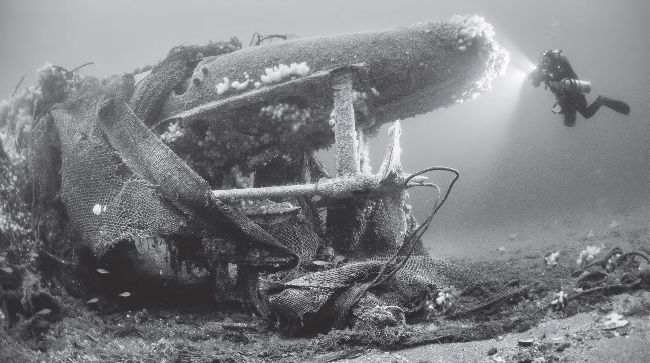
Diver on the stern of the U-12.
JUST OVER A CENTURY AGO, a new age of global warfare was about to be ignited. The year was 1914. World War One had been raging for only a couple of months, but shocking human losses had already been suffered.
Britain had lost its first ship to a German U-boat torpedo - HMS Pathfinder, off the Firth of Forth on 5 September. Although the loss of 261 sailors was shocking, the sinking was written off in many circles as a lucky shot.
Britain had yet to take U-boats seriously, but this would soon change.
A few weeks later, on 22 September, U-9 captained by Otto Weddigen was patrolling the southern North Sea.
Within an hour of spotting three British armoured cruisers all had been lost to the U-boat’s torpedoes, with the terrible loss of 1459 British sailors.
This engagement sent shockwaves around the British Empire - the age of the submarine had begun.
Two months earlier, U-9 had been the first submarine to reload her torpedotubes while submerged.
Including her first engagement she sank 18 ships, and was one of only two vessels awarded the Iron Cross by Kaiser Wilhelm II.
Her sister-sub, U-12 was the first U-boat to launch a seaplane while at sea. The two Type U-9 submarines, along with U-10 and U-11, made up I Flotilla.
IT’S 11 AT NIGDHT ON 10 JULY, 2019. Sitting in my van in Eyemouth Harbour about to retire to Wavedancer II (a diveboat on which I work through summer), I remember a post I’d seen on the North Sea Divers Facebook page.
It was requesting divers’ help in obtaining some key measurements of U-12, a wreck dived from Eyemouth, where most of my diving happens.
I have dived 10 submarines around the UK and, although it’s time for bed, decide to message Pete Hamman to find out about this project he’s working on.