INDEFINABLE MAGIC
“Creaking doors, thunder and lightning, monsters and all the things that go bumpety-bumpety in the night.” DWM investigates the weird world of the supernatural in the Doctor Who universe…
FEATURE BY STEVE LYONS
Ghosts are real in Doctor Who.
There is no doubt about it any longer. The Doctor encounters them in the Drum, an underwater facility in 2015’s Under the Lake, and concedes that they are just what they appear to be – to his companion’s surprise.
“You said there was no such thing,” protests Clara Oswald. “You actually pooh-poohed the ghost theory.” She’s right. In fact, she is more right than she knows.
When it comes to ghosts – and indeed, all matters paranormal – the Doctor has a long history of avowed scepticism. In 1971’s The Dæmons, Jo Grant only has to mention “the dawning of the Age of Aquarius” for him to retort: “I’m obviously wasting my time trying to turn you into a scientist!” “Well, how do you know there’s nothing in it?” Jo challenges him. “Well, I just know, that’s all. Everything that happens in life must have a scientific explanation – if you know where to look for it, that is.”
So, when Benton is later attacked by invisible spirits, the Doctor insists that the culprit must be “a forcefield… even a psionic one”. “You’re being deliberately obtuse,” argues self-declared white witch Olive Hawthorne. “We’re dealing with the supernatural, the occult, magic.” “Science!” the Doctor barks back.
He’s just as quick to scold Leela for using the M-word, in 1977’s The Robots of Death. “I know, I know,” she apologises, “there’s no such thing as magic.” “That’s right,” the Doctor avers. “To the rational mind, nothing is inexplicable, only unexplained.” In 1986’s The Trial of a Time Lord, Peri refers to “the spooks and ghosts you’re always telling me don’t exist” – while in the TV Movie, the Doctor states, “I don’t believe in ghosts!”, which seems pretty unequivocal.
“Yes, well, well,” he defends his complete about-turn in the Drum, “there was no such thing as, as socks or smartphones and badgers until there suddenly were… No, these people are literally, actually dead… I’ve never actually met a proper ghost!”
But that depends on how you define the word, of course…
At some point prior to 1989’s Battlefield, the Doctor taught Ace ‘Clarke’s Law’ in reality, the third of science-fiction writer Arthur C Clarke’s famous Three Laws. “Any sufficiently advanced technology,” Clarke decreed, “is indistinguishable from magic.” Ace misquotes him slightly, but retains his gist.
The point has been demonstrated often in Doctor Who. The Face of Evil (1977) and The King’s Demons (1983) spring to mind: two stories in which primitive societies mistake the Doctor himself for an evil, supernatural entity.
In 2015’s The Girl Who Died, the Doctor paraphrases Clarke’s Law again, before attempting to convince a tribe of Vikings that he is their god Odin, using a yoyo. He should have known it wouldn’t work, having failed to pass himself off as Zeus by dint of his “supernatural knowledge” in The Myth Makers (1965)…
So, when Henry Gordon Jago sees a ghost backstage at the theatre (The Talons of Weng-Chiang, 1977), there is a rational explanation. It’s a hologram, designed by time traveller Magnus Greel to guard his lair from superstitious Victorians. Makes sense to those of us who, in more enlightened times, are familiar with Scooby-Doo.
The woods around Fetch Priory are also reputed to be haunted (Image of the Fendahl, 1977), though in this case the Doctor blames a “time fissure… a weakness in the fabric of space and time. Every haunted place has one, doesn’t it? That’s why they’re haunted. It’s a time distortion.” What, every haunted place?
A similar fissure brings the disembodied Gelth to Cardiff in 2005’s The Unquiet Dead - although the Doctor calls this one a ‘rift’. “A weak point in time and space,” he explains in familiar terms, “a connection between this place and another. That’s the cause of ghost stories, most of the time.” So, most haunted places, then.
One morning, Earth wakes to find “ghosts, everywhere” – including one in Jackie Tyler’s flatthat “just feels like” her father (Army of Ghosts, 2006). In fact, the apparitions are Cybermen from a parallel Earth, each forging a ‘psychic link’ with the bereaved in order to pull themselves into our dimension. Which is far more logical and believable than the ghost theory because, you know, science…
Similarly, Caliburn House is haunted by “the Witch of the Well… an objective phenomenon, but objective recording equipment can’t detect her”, so we’re told. Or, if you prefer, by pioneering time traveller Hila Tacorien, trapped in a collapsing pocket dimension in 2013’s Hide.
Clarke’s Law, then, performs an invaluable function in Doctor Who. It allows for anything, anything at all, to be true – as long as it can be blamed on science beyond our understanding. We can choose to accept the Doctor’s reassurances and believe that his adventures still take place within a rational universe.
He lays this conceit bare in 2006’s The Girl in the Fireplace, upon finding what he calls “a spatio-temporal hyperlink”. Asked what this is, he replies, “No idea. Just made it up. Didn’t want to say ‘magic door’.” 2014’s Last Christmas makes the point that the Doctor’s existence is no less probable than that of (the fictional) Santa Claus
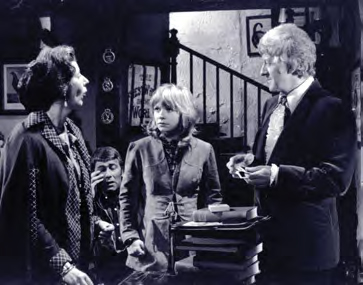
Miss Hawthorne clashes with the Doctor over mattters of magic versus science.
The Doctor is tripped up by Clarke’s Law himself in 1965’s The Chase. Menaced by Count Dracula and Frankenstein’s Monster in a haunted house, he knows things can’t be as they seem: “This house is exactly what you would expect in a nightmare… Yes, yes, it exists in the dark recesses of the human minds. Millions of people, secretly believing… makes this place become a reality.”