THE DWM INTERVIEW
BRUSHING UP
In the last few years of Doctor Who’s original run, digital technology opened up new possibilities for video effects. NEIL OSEMAN speaks to matte artist JIM McCARTHYabout his work with the Quantel Paintbox.
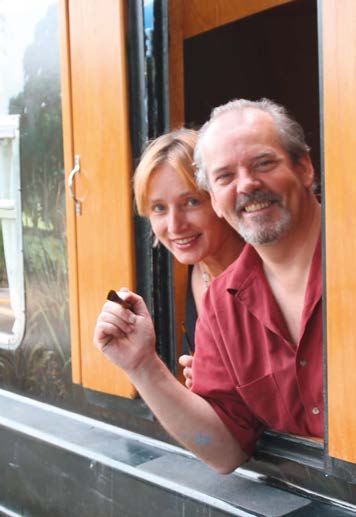
Matte artist Jim McCarthy and his wife Ruta.
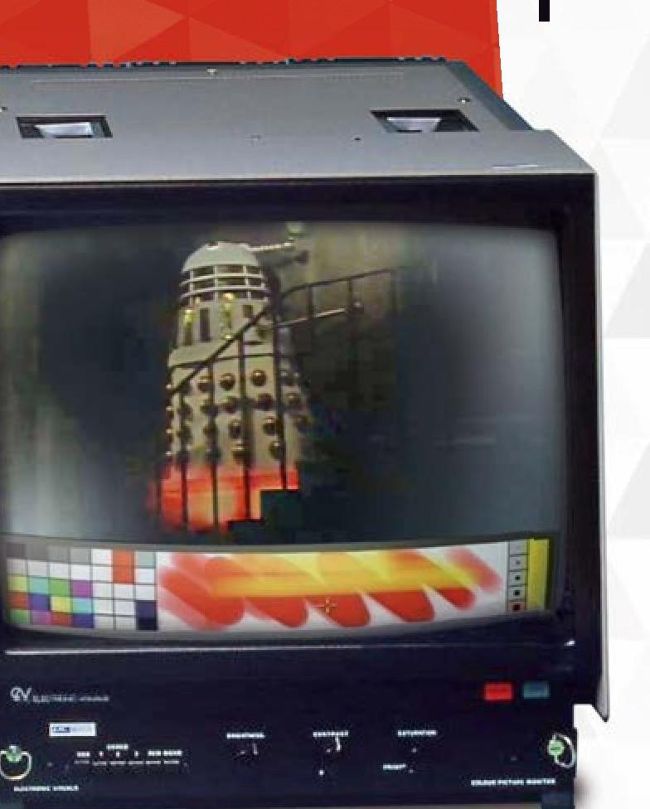
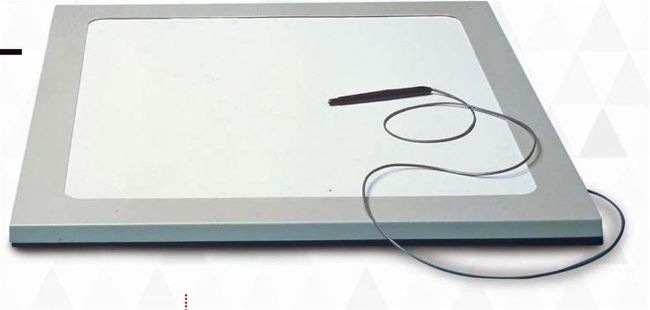
The Quantel Paintbox DPB 7001, a 2D graphics workstation first used by the BBC in 1986.
Jim’s glass matte painting of the Tranquil Repose pyramids, as seen in Revelation of the Daleks (1985).
Jim McCarthy was teaching art in Glasgow when a friend made him aware that the BBC had vacancies for matte painters. “I was interested in film and I was wanting out of teaching,” he says.
“I was already trying to work as an illustrator.” Matte painting involves placing a sheet of glass in front of the camera and painting elements like distant hills and buildings onto it, perfectly aligned with the real view visible beyond. But when Jim got the BBC job in June 1984, union rules meant that he wouldn’t be matte painting full time. Rather, he was designated as a scenic artist and placed in a rotor system under which he alternated matte work with other painting tasks like portraits, murals and backdrops.
One of Jim’s earliest Doctor Who assignments involved the setting for the 1985 story Revelation of the Daleks. He assisted Annie Ralli in creating a glass matte painting of the Tranquil Repose pyramids, augmenting location footage shot at IBM’s headquarters in Portsmouth. “I saw the very first Doctor Who [in 1963],” remembers Jim, a sci-fi aficionado. “I was a big Doctor Who fan, so it was a bit of a thrill for me to work on it.”