PIXEL PERFECT
The game developers striving to get closer to the past, one glowing dot at a time
By Paul Walker-Emig
There’s a shift happening in the way people think about videogames inspired by years gone by. As the quality of the pixel art in Square Enix’s Final Fantasy remasters sparks hot debate, interest in how display technologies impact on game art is buoyed by the likes of the popular CRT Pixels Twitter account and the market grows for products that help people get better image quality from vintage consoles on modern displays, there’s a related trend emerging for developers to push the inspiration they take from the videogames of the ’80s and ’90s to new extremes. Not very long ago, giving a game a retro vibe involved simply rendering it with pronounced pixels. Nowadays, it goes a lot deeper than that.
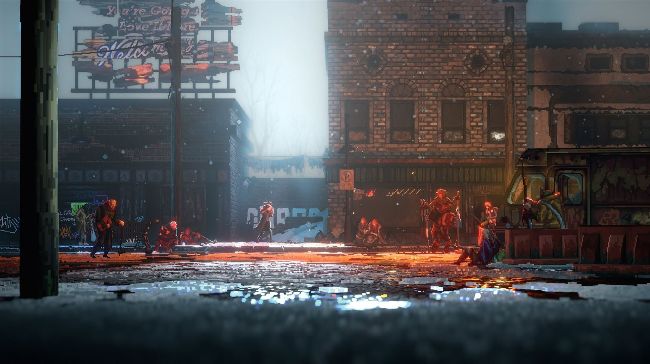
Set in an alternative 1980s,
Replaced doesn’t even pretend to be authentic to vintage hardware, although it does feature in-game CRT tech inspired by the real thing
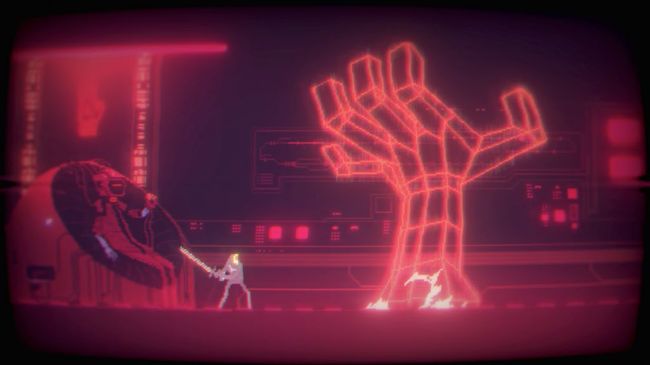
Studio Koba’s Narita Boy, released on all major platforms earlier this year, isn’t about capturing the precise visual fidelity of old games but “a feeling of something lost”
Modern videogames taking inspiration from old ones is, of course, nothing new: after the indie gaming boom of the late 2000s, we were inundated with 16bit-inspired pixel art games. Over time, however, pixel art has transformed from being synonymous with retro revivalism to become an aesthetic of its own. In videogames such as Narita Boy, Demon Throttle, Arcade Paradise, Cursed Castilla, Super Hydorah and Blazing Chrome, we’re seeing a move to re-establish that connection to the past by going way beyond simply using pixel art to evoke times gone by. These games attempt to emulate the look and even the sound of the technology of earlier eras, leaving us in no doubt about their desire to transport us to another time. What is motivating developers to push things to another level, and how are they achieving it?
For Ed Fornieles, creative director of Narita Boy, from Spanish team Studio Koba, the answer is deeply personal. “I made a retroinfluenced game because I wanted to explore my own experience from that time, when I played as a kid on the arcade cabinets in my village in the summers of the ’80s,” he says. “I wanted to talk about nostalgia, as a player, as a child, and create the aesthetic of it. I wanted to capture a feeling of something lost, a time that has gone and is never going to come back –a time when my generation grew, looking at what we experienced, the way games and cultural products were made, with everything wrapped in a kind of innocence.”
To do that, Narita Boy uses pixel art as a basis but goes significantly further, emulating some of the artifacts of vintage CRT televisions using a combination of post-processing filter effects powered by Unity. “Many people said, ‘Why are you pouring on this amount of filters? Your pixel art looks gorgeous,’” Fornieles recalls. “My answer was that it is not about the art itself, it’s about the feeling.”
DEMON THROTTLE IS COMMITTING TO ITS RETRO PREMISE TO THE EXTENT THAT ONLY PHYSICAL COPIES OF THE GAME WILL BE RELEASED