BUILT TO LAST
Has Roblox finally become impossible for the wider industry to ignore?
By Jeremy Peel
As tourists step off the steamboat into the Giant Man Experience Centre, a few fail to mind the gap and fall into the abyss below. Listen carefully and you can hear them roar as they despawn, their limbs exploding outward in a bloodless gibbing. Those that do make it inside the glass-walled building admire the model display cabinet that contextualises the 175-metre Giant Man alongside the Eiffel Tower (318m) and Ireland’s Tallest Tree (56m). There’s a ‘bing-bong’ as one guest presses the big green button on the nearest Information Point and an amiable Irish voice rings from the speaker: “We here at the Giant Man know that you have a choice of Giant Men to visit, and we appreciate you choosing us. We hope you have a very nice time today.”
The voice belongs to Terry Cavanagh, the acclaimed developer of games such as Super Hexagon and Dicey Dungeons. But the button, and everything attached to it, comes from Roblox, the user creation platform. It’s the meeting of the two that has piqued our curiosity and brought us here, to the size-879 feet of Cavanagh’s Giant Man.
“I guess I’ve been playing a lot of Roblox games,” Cavanagh says. When the pandemic hit, he and his friends cycled through a number of multiplayer options to keep their social life breathing. After Tabletop Simulator and Everybody’s Golf, they landed on Roblox’s endless library of experiences. “It was this huge discovery for me personally,” Cavanagh says. “I didn’t really know anything about it. I knew it was a kid’s platform, and I had heard that it was very microtransaction-y. That’s where I started.”
Roblox is the quintessential post-Mine craft phenomenon: enormous, genreless, ineffable, an industry unto itself. At the height of lockdown last August, it drew in an estimated 164 million monthly users, and was played by more than half of all American children under the age of 16. Both game and development tool, Roblox is comparable to other user creation platforms such as Rec Room, Core and Dreams. Yet for the most part it has sat adjacent to the game industry, rarely discussed and little understood, perhaps because of its young audience. (Though Roblox Corp points out that, during the first quarter of this year, nearly half of its userbase was over the age of 13.)
“I couldn’t really tell you why it has been so separate,” Cavanagh says. “It’s kind of mysterious to me, having gotten more familiar with it in the last year. It’s like this whole parallel industry. They’ve just been quietly doing their own thing. There’s a ton of interesting creative work happening, and a lot of people are suddenly just looking over and realising that it’s been there all along.”

Roblox’s
toolset
tends
to
extend
to
its
players.
Adopt Me houses can be customised.
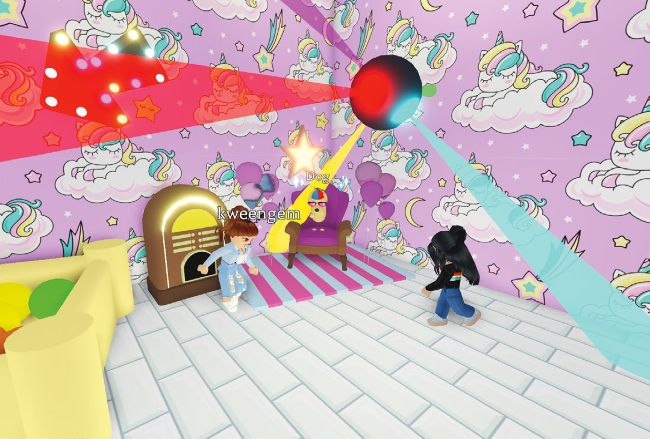
Adopt Me’s public environments foreground colour in a way that delights its intended audience
That disconnect has been a long-term frustration for Josh Ling, who has built a career in spaces dismissed by the game industry at large. In his previous role at Hypixel, he led a team of 30 in operating Minecraft’s largest multiplayer server, supplying minigames to an audience of more than 13 million. Now he’s director of business operations for Uplift Games, a newly formed studio spun out of the success of a single Roblox-powered game. Adopt Me is the single most popular game on the platform, and the numbers are nothing short of extraordinary: 22 billion visits, 1.92 million of which happened concurrently on one day in April, following the launch of its Ocean Egg update. For context, that’s almost double the strongest concurrent performance of Counter-Strike: Global Offensive, Steam’s most popular game. Yet when Ling talks to peers in the traditional game industry, he finds most are ignorant of the scale at which Roblox operates. They are unaware of the Giant Man that looms over them.