XR
Vision quest
Apple finally reveals its XR hardware as Meta scrambles to hail the arrival of a revised Quest
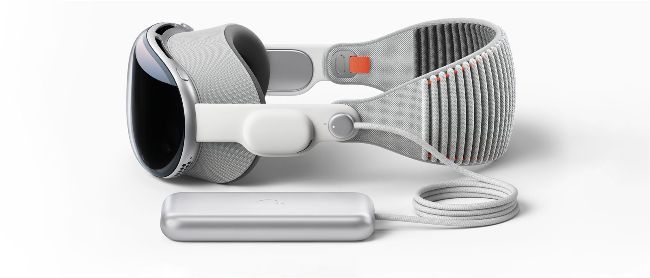
As a wearable, the Pro Vision hardware shows the same attention to detail in its materials as the Apple Watch line. Alongside the fabric-based strap and the outward-facing display, one of its most unexpected quirks is the reliance on an external battery
Just as expected, Apple’s entry into the world of extended reality (or XR, encapsulating both VR and AR) diverges from the path trodden by the likes of Meta and Valve. However, rather than presenting something that gets closer to the construction ideal of a pair of spectacles, the company’s Vision Pro hardware, unveiled at its WWDC event in June, turns out to be almost as obtrusive as any other headset we’ve been invited to strap to our faces in recent years.
And it has to be: in order to deliver the kind of performance required to facilitate its unique feature set, the Vision Pro headset is loaded with more technology than has ever been crammed into such a device, with Apple’s M2 silicon working in concert with its new R1 chip, which is designed specifically to process input from the hardware’s sensors, mics and 12 individual cameras. It needs so many of the latter partly because of the system’s control interface, which eliminates additional physical controllers in favour of parsing movements of your head, hands and eyes.
While eye-tracking isn’t a new concept for XR – it’s supported by PSVR2 and Meta Quest Pro, for instance – and controller-free gaming is an option with hardware such as Quest 2, the difference with Apple’s solution is that these are cornerstones of the Vision Pro experience rather than options. The goal is to make operation as seamless as possible, allowing it to become absorbed into your life with as few obstacles as possible. In navigating menus, for instance, there is no pointer projected into the display to show precisely where you’re looking; instead, you simply gaze at the desired option and tap your fingers together to confirm the action. In carefully staged demos at WWDC, the system holds up well, delivering on one of Apple’s unofficial marketing lines – ‘It just works’ – and it is clear that an immense amount of thought (and time, and millions of dollars) has been invested in a product aiming to deliver on the promise of ‘spatial computing’ when it launches.