TECH
BUILDING ELECTRICALLY SAFE VEHICLES
A Guide for the Aftermarket EV Community
WORDS AND PHOTOS BY LEGACY EV
AS electric vehicles (EVs) continue to revolutionize the automotive world, a passionate group of enthusiasts is driving another revolution: converting gaspowered vehicles to electric. Whether you’re working on a classic car conversion or building a custom EV from the ground up, safety should be your top priority. High-voltage (HV) systems bring unique risks that must be managed with care. In this article, we’ll explore the essential safety components and protocols to ensure your EV project is both powerful and safe.
High-Voltage Interlock Loop (HVIL)
When you’re dealing with highvoltage systems, the High-Voltage Interlock Loop (HVIL) is your first line of defense. Think of the HVIL as an alarm system for your EV’s electrical components. It’s a continuous loop that runs through all HV connectors and components. If someone accidentally disconnects a plug or if a connection is damaged, the HVIL detects it immediately because there is no longer electrical continuity through the HVIL circuit.
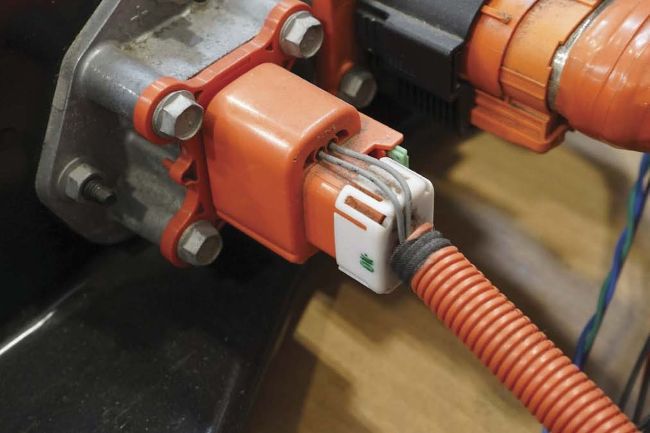
THIS HV heater element harness from a Nissan Leaf has HVIL external to the connector housing.
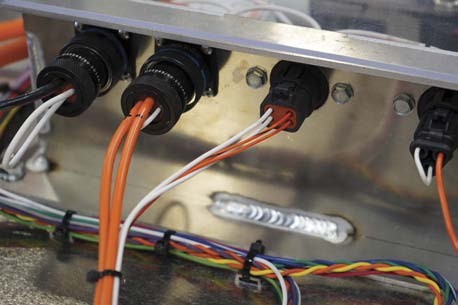
AS seen on this Legacy EV training bench, each HV connection (orange) also has a corresponding HVIL interlock connection (white)